

By Cat Murphy, Haley Parsley, Josephine Johnson and Molecule Jongwilai
Howard Center for Investigative Journalism
Human errors and track defects caused more than 3,000 rail accidents over the last decade, killing 23 people and injuring nearly 1,200. Yet federal railroad regulators failed to implement most of the safety recommendations that emerged from the accident investigations.
That’s according to an original analysis by the Howard Center for Investigative Journalism at the University of Maryland.
Behind those numbers, the Howard Center found, is a powerful industry that uses its money and influence to stymie federal safety reforms and is actively lobbying President Donald Trump’s administration to further reduce track inspection and repair requirements, loosen rules aimed at preventing crew fatigue and hide safety data from regulators and the public.
The center’s analysis of data from the National Transportation Safety Board, which investigates major accidents and recommends safety improvements, found it gave federal railroad regulators 81 recommendations from 2015 through 2024. The Federal Railroad Administration has only fully implemented five of them — the lowest rate of any regulatory agency in the Department of Transportation.
Three of the lingering safety recommendations came out of a 2021 derailment of Amtrak’s Empire Builder passenger train in Joplin, Montana.
Zach Schneider, 28, was watching Montana’s Great Plains roll by from the observation car of the long-distance train. Margie and Don Varnadoe, on a trip to celebrate their 50th anniversary, were walking between cars. All three were thrown to their deaths just before 4 p.m. on Sept. 25, when the train derailed, injuring 49 people.
An investigation by the safety board blamed the tragedy in part on worn-down rail and other defects in the tracks owned by BNSF Railway — defects the company inspector likely missed due to his workload, according to the NTSB.
But board officials went further, citing the FRA’s failure to set rules for track replacement or workloads. The safety agency recommended both measures repeatedly after previous rail accidents.
FRA spokesperson Warren Flatau said the agency has 102 open safety board recommendations, some dating back as far as 1998, and “is currently taking action or planning to take action” on more than 70% of them.
He said the FRA plans no immediate action on the rest, generally because officials have determined they are infeasible or can be addressed with existing regulations.
The agency has not responded to the Howard Center’s request for additional information on what actions the FRA is taking.
To understand why rail safety initiatives have fared so poorly, the Howard Center examined the fate of safety reforms accident investigators recommended repeatedly following major accidents over years, even decades.
The analysis revealed a recurring cycle of industry opposition, FRA inaction, congressional capitulation and tragedy.
When contacted for comment, the three major American freight railroads included in this story — BNSF, Norfolk Southern and Union Pacific — did not dispute any of the facts or findings. All sent statements saying they are committed to safety.
Deadly track defects
In 1980, a train carrying vinyl chloride — the same cancer-causing chemical at the center of the 2023 disaster that enveloped East Palestine, Ohio, in a cloud of toxins — derailed in Muldraugh, Kentucky, causing two carloads of the flammable gas to spill and catch fire, and a third to vent hazardous fumes. Four crew members were injured and about 6,500 people were evacuated from the surrounding area.
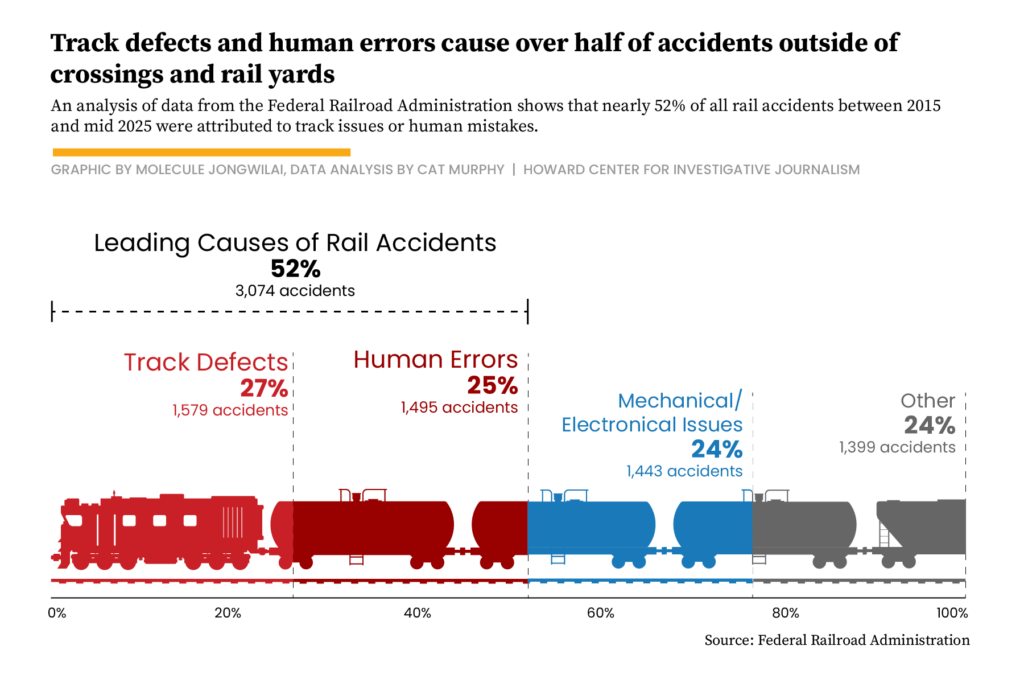
Investigators concluded the accident was caused in part by dangerously worn-down rail. Worn rail is one of several types of track defects that, collectively, contribute to around a quarter of the rail accidents in the United States.
Following the derailment, the safety board called on regulators to set a limit on how much wear a rail can sustain before it has to be replaced. But the FRA never addressed the issue. Later, a 1998 study sponsored by the FRA found such limits would improve safety, but it still did not take action.
In the 45 years since the Muldraugh derailment, 44 people have died and another 2,300 have been injured in nearly 15,000 main-line accidents blamed on track defects, according to the Howard Center’s analysis of FRA accident data.
The fatal Montana derailment occurred on one of the busiest long-distance tourist routes in the U.S. — Amtrak’s Empire Builder, which carries hundreds of thousands of passengers each year between Chicago and the Pacific Northwest.
NTSB officials found the rail wear limits they recommended in the 1980s would have required BNSF, the nation’s second-largest railroad, to replace the rail involved in the accident.
The safety board again in July 2023 recommended the FRA regulate rail wear. A month later, the agency responded that it was “committed to working with NTSB to prevent future accidents and save lives” and said it “welcomes and will consider all recommendations that will further that goal.” The NTSB website showed no further response from the FRA as of publication.
A BNSF inspector had driven over the track in a company vehicle twice the week of the accident — meeting FRA regulations — and documented concerns about that section of track. But the inspector didn’t get out to walk the tracks, something NTSB said likely would have identified defects. There had been no reported walking inspection in nearly a year. In a statement, BNSF said it inspects its tracks in excess of federal requirements.
“This tragedy is a powerful reminder that there’s no substitute for robust track inspection practices, which can prevent derailments by identifying track conditions that may deteriorate over time,” NTSB Chair Jennifer Homendy said in a statement accompanying the findings. “I implore track owners, who are responsible for the safety of their routes, to ensure inspectors have the time, support, and resources needed to do their work, which is essential to rail safety.”
Following the accident in Joplin, the NTSB also recommended the FRA require trains to slow down when an automated inspection detects a potentially critical defect until a walking inspection is performed and repairs are completed. The NTSB is still awaiting a response.
Meanwhile, the industry’s largest trade group is pushing to reduce human inspection requirements.
One of the Trump administration’s top priorities has been to cut government bureaucracy. Earlier this year, after establishing its Department of Government Efficiency, the administration publicly sought ideas on how to deregulate the federal government.
In May, the Association of American Railroads, the trade group that represents the largest and wealthiest railroads in North America, suggested reducing the frequency of required human track inspections in favor of increased automated inspections — a move it argued would “improve safety and reduce regulatory costs.”
On Dec. 5, federal regulators granted AAR’s request to let railroads do just that. The FRA approved a waiver that will allow participating railroads to cut weekly visual inspections in half, provided they comply with a number of other safety and reporting requirements.
The trade group said in a statement that it believes railroads should combine unmanned track inspections with visual inspections by humans. It did not respond to repeated questions about the reduction in visual inspections it proposed in May.
The NTSB says automated inspections are a supplement to human inspections, not a replacement for them, in part because neither method is 100% effective.
In a statement, BNSF said employing this technology allows the company to detect and repair defects more quickly.
Automated inspection technology excels at identifying certain track defects, even if they may not be visible to the human eye — such as if one rail is higher than the other, or the rails are too far apart, said Lance Marston, a rail inspector for Norfolk Southern. But the technology isn’t designed to detect over two-thirds of rail issues human inspectors are trained to look for, including broken rails, according to data from both the AAR and rail workers’ unions.
“There’s just no replacement for getting out there and putting boots on the ground,” Marston said.
Norfolk Southern said in a statement that automated technology is just one part of the company’s inspection process and human inspectors play a “critical role” in evaluating the technology’s assessments.
Christie Lee, who has worked as a track inspector for BNSF Railway for the past two decades, said the introduction of automated inspection technology has meant a reduction in inspectors and an increase in workload.
“We used to ride, like, 70 miles … and we used to have three track inspectors,” said Lee, whose territory now covers over 90 miles of track running from southern Wyoming and into Nebraska. “Now it’s solely on two guys, two people, to ride the whole thing.”
Lee said she has also seen a decrease in inspection frequency since her railroad rolled out automated inspections.
“We rode seven days a week. Then they cut us down to five times a week. Then it was three times a week and now it’s once a week,” she said. “It’s just a matter of time that something happens.”
Infrequent or inadequate rail inspections have had deadly consequences, including the fatal derailment in Montana.
An inspector in a BNSF maintenance vehicle rode over the accident site two days before the derailment and noted some track anomalies.
But he didn’t stop to look closer and missed critical defects that led to the derailment. He probably didn’t have the time, NTSB investigators surmised. That day, he had worked for 16 hours to inspect his assigned 127 miles — “an excessive amount” of track, according to the NTSB. Investigators faulted BNSF’s safety culture, finding the railroad hadn’t done enough to manage employee workloads.
Fatigued workers, the NTSB reminded the company, make mistakes. It was a message the board had repeated since at least 2004.
Fatal fatigue
In the pre-dawn hours of June 28, 2004, a Union Pacific engineer was operating on less than two hours’ sleep when he blew through a signal light and collided with a BNSF train in a quiet neighborhood in Macdona, Texas. Over 9,000 gallons of liquid chlorine escaped from a punctured tank car and vaporized, engulfing the area in a cloud of chlorine gas that suffocated the conductor and two local residents, and left 30 people in severe respiratory distress.
The engineer had gone to bed late the night before after visiting his daughter and playing cards with a friend. His first shift that weekend had ended Saturday afternoon, but only 9 ½ hours later, he’d reported for a 12-hour overnight shift, which ended just before noon on Sunday. At 2:45 a.m. on Monday, he was called in to operate the Union Pacific locomotive that would crash less than three hours later.
NTSB’s investigation found the engineer’s fatigue — triggered by a chronic lack of sleep, disrupted sleep cycle and long work shifts — led to the fatal mistake that caused the collision.
Like many freight train employees, the Union Pacific crew worked on-call, as opposed to having set schedules. Regulators give railroads broad discretion over crew scheduling, and employees are expected to adapt. Dramatic shifts in sleep time and patterns increase the likelihood rail workers will make mistakes.
In a statement, the AAR said the “dynamic” nature of railroad operations “presents unique scheduling challenges.” The industry, it said, “continues to invest in tools, technology, and collaboration to support employee well-being and operational safety.”
But in its request to the Trump administration to roll back regulations, the industry argued regulatory mandates aimed at preventing fatigue-related accidents are overly burdensome. The mandates, the AAR said, create opportunities for employees to abuse fatigue-related protections.
The Howard Center asked the AAR to provide examples of abuse or potential abuse of fatigue-related protections by employees, but the AAR did not respond to repeated requests for clarification.
Employees say fatigue protections would help address human error by rail workers.
“If I go back through my career as an engineer and I think about mistakes that I made, I can almost attribute all of them to fatigue,” said Scott Bunten, a general chairman for the Brotherhood of Locomotive Engineers and Trainmen, one of the two major rail unions.
In 2006, the safety board recommended the FRA better regulate crew scheduling practices and require railroads to take into consideration factors cited in the Macdona crash, like sleep debt, which is the cumulative loss of sleep that occurs when a person doesn’t get enough daily rest over a long period of time. But the FRA didn’t take action.
Less than two years later, as part of the Rail Safety Improvement Act, Congress mandated implementation of fatigue risk management plans in the freight rail industry. It also said railroads were responsible for screening employees for sleep disorders and providing fatigue training.
The Department of Transportation was required to issue a regulation by late 2012 requiring railroads to adopt fatigue risk management plans. But the FRA did not finalize a rule mandating them until 2022 and didn’t finish reviewing plans until earlier this year.
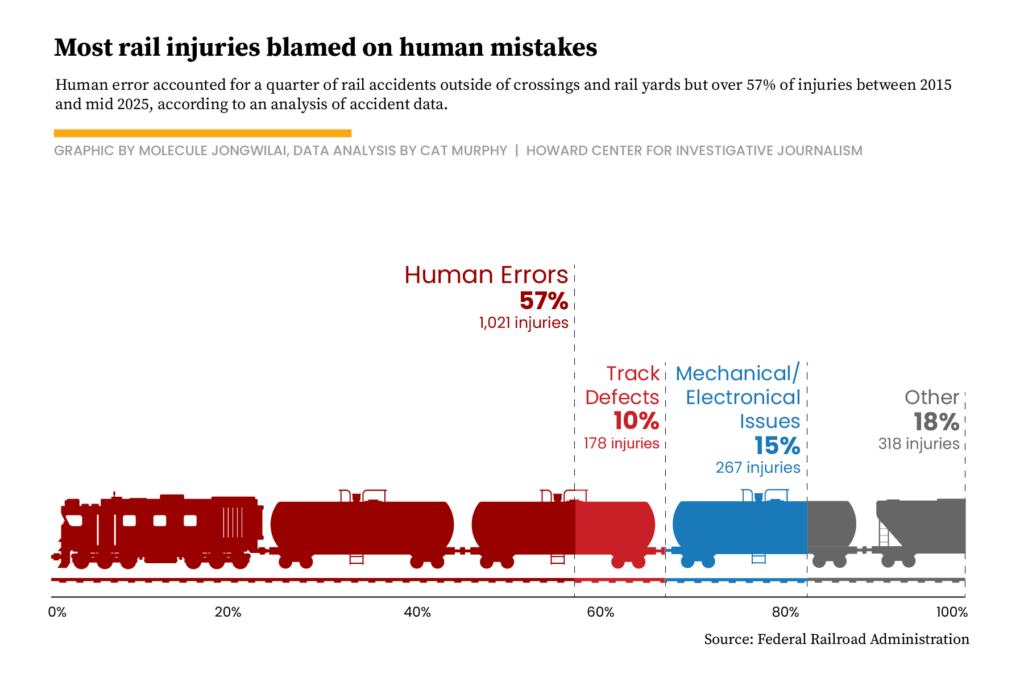
Fatigue-related accidents killed at least nine people and injured over 330 from 2015 through 2024, according to an analysis of data from NTSB and FRA.
Under the Trump administration, progress will likely be stalled further.
The AAR’s deregulatory wish list included repealing a requirement for minimum two-person crews and reducing the administrative requirements associated with fatigue management plans.
Railroad workers have the option to take personal rest days to avoid fatigue, but crew members told the Howard Center they feel uncomfortable requesting time off.
“They just want bodies on the trains, and honestly I don’t think they care if they’re fatigued or not,” former NTSB investigator Rick Narvell said.
Decades of delays, injuries
Positive train control, or PTC, works as a safety net against human error. By combining advanced GPS, cruise control and automatic emergency braking, PTC systems are able to prevent accidents most often caused by human error — such as train-to-train collisions and over-speed derailments — by automatically enforcing speed limits, track restrictions and stop signals.
Yet, the industry employed stall tactics to delay its implementation for half a century. In the meantime, more than 300 people died and 6,800 suffered injuries in 154 PTC-preventable accidents, according to an NTSB tally.
In a statement, the AAR said the delay was caused by the “complexity and scale” of technological development.
The rail industry, including the AAR, began working on PTC technology and policy in the 1990s, according to records reviewed by the Howard Center. Some PTC technology was developed by 2008 but was not fully rolled out for another 12 years.
The idea for an automated form of train control had been floating around since 1922, and in 1970, the NTSB first recommended the FRA study the feasibility of requiring such a system after a preventable head-on train collision killed four and injured 43.
NTSB placed PTC on its list of “most-wanted” transportation safety improvements in 1990. By then, 71 PTC-preventable accidents had already killed 197 people. Another 66 would die in preventable accidents over the next 15 years.
Four spectacular accidents over a two-year period the NTSB said PTC could have prevented captured the public’s attention.
The June 2004 Macdona accident could have been prevented, despite the crew fatigue, had PTC been in place, the NTSB found.
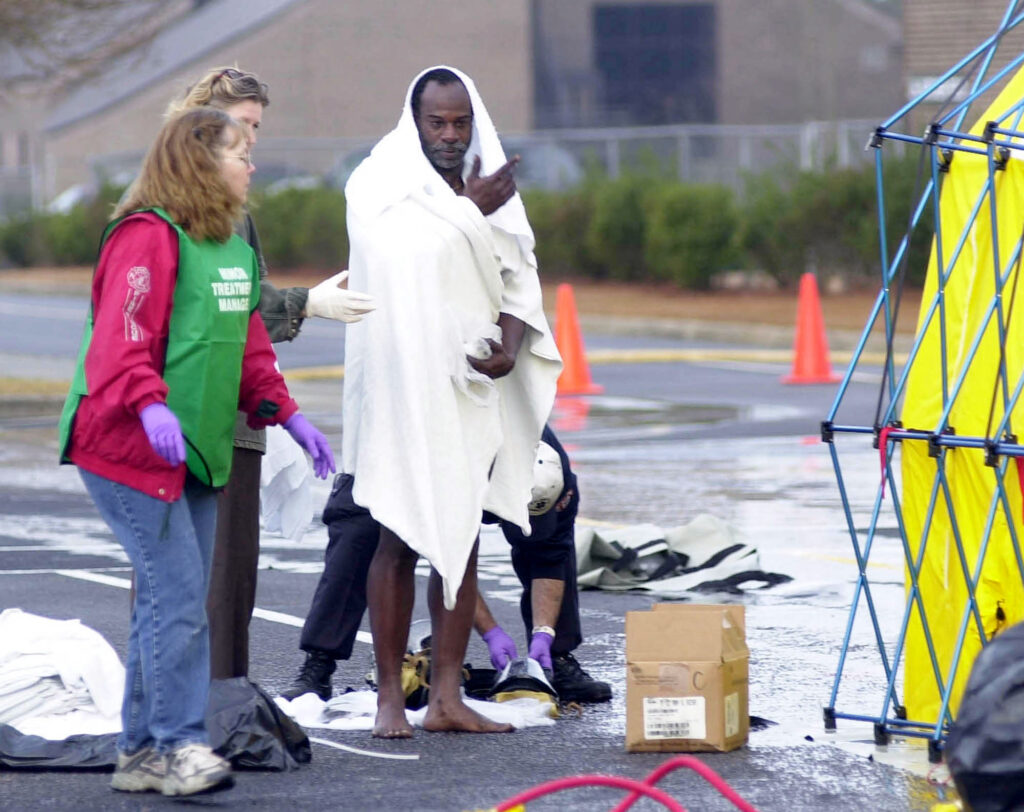
In January 2005, nine people died, 550 were injured and thousands were forced to flee in Graniteville, South Carolina, when a collision released chlorine gas. The last death was the train’s engineer, who survived the collision and called for help before he succumbed hours later.
Six months later, two trains collided head on in Anding, Mississippi, killing both crews and leaking 15,000 gallons of diesel fuel, which burned for 15 hours and prompted the evacuation of about 100 people.
In October 2005, a Union Pacific train ran into the back of a stationary Union Pacific train in Arkansas, puncturing a car containing flammable propylene gas. It flowed along the ground at 5 a.m. into a nearby neighborhood and inside a house, which exploded, killing one person inside. The gas also caused a second house to explode and burned a wooden railroad trestle. More than 3,000 people were evacuated.
When the U.S. House passed the Rail Safety Improvement Act in October 2007, it included a provision requiring railroads to implement PTC systems. But it would take one more horrendous accident to push the bill over the finish line.
In Chatsworth, California, an employee operating a Metrolink commuter train while texting ran through a stop signal on Sept. 12, 2008. He plowed into a freight train, killing 25 people. “A positive train control system would have stopped the Metrolink train short of the red signal,” the NTSB concluded, “and thus prevented the collision.”
Union Pacific, which operated the struck freight train, said in a statement the accident was not caused by technical issues but by the employee operating the Metrolink train, who was texting at the time of the accident.
A month later, President George W. Bush signed the legislation mandating PTC be installed on most major rail lines — including all Class I freight carriers transporting hazardous materials — by the end of 2015.
The industry immediately began a multifront battle to delay that deadline.
The AAR sued the FRA over the PTC rule and on Capitol Hill, the industry poured money into lobbying and campaign contributions while seeking delay.
The AAR spent heavily on lobbying from 2008 through 2015, a Howard Center analysis of the organization’s quarterly disclosure reports shows. Although the reports don’t break down costs by issue, the AAR listed PTC among its targets for influence on filings that totaled $69 million. The trade organization also spent $25.4 million in the four election cycles from 2008 through 2014 — $4 million more than they had spent in the previous nine election cycles combined.
Two months before the PTC rule was set to go into effect, Congress pushed back the compliance deadline to 2018, with extensions available until 2020.
In December 2017, a father had just removed his young child from a car seat for a bathroom break when their Amtrak train, traveling at 80 mph in a 30 mph zone, derailed and fell off an overpass in DuPont, Washington. The child’s empty car seat and five of the train’s passengers were found among the wreckage on the interstate below. Three passengers were killed and 65 were injured, including eight drivers whose vehicles were struck by debris.
Had PTC systems been in place by the original 2015 deadline, it could have prevented the accident by automatically slowing the train, the NTSB found.
But PTC wouldn’t be fully implemented on required rail lines, including Amtrak, until 2020 — five decades after the NTSB had first recommended the technology.
In that time, hundreds died and thousands more were injured in crashes the NTSB said could have been prevented with PTC technology.
Deregulation wish list
When the Trump administration invited public input into how to shrink the federal bureaucracy this spring, the AAR responded within two weeks with a 31-page spreadsheet that itemized 80 regulations for modification or repeal. The spreadsheet laid out an expansive deregulatory agenda that would markedly reduce federal oversight of an industry that carries billions of passengers and millions of gallons of toxic chemicals through thousands of communities.
In the letter that accompanied it, the trade organization stated its aim was to cut through regulatory red tape in a “manner that is consistent with railroad safety.’’
University of Maryland reporters Mary Burke, Taylor Nichols, Adriana Navarro and April Quevedo contributed reporting and data analysis for this story.
Data analysis methodology
The Howard Center analyzed more than 137,000 unique railroad accident reports filed with the Federal Railroad Administration between 1980 and 2025. The data includes detailed information on reported rail accidents, including date, location, cause, injuries, fatalities and damages. It does not include accidents that were not reported because they didn’t meet the federal minimum for reportable damages, which is currently $12,600.
To avoid artificially inflating the level of public risk, this analysis focused primarily on accidents that occurred on main lines or sidings and excluded those that occurred in rail yards and on private industry tracks. Accidents at highway-rail crossings were also generally excluded because they were not exclusively rail accidents. This investigation looked primarily at data from the past decade because the number of reported accidents has remained relatively stagnant over that period, and figures from prior years aren’t representative of the industry’s current safety record.
Accidents were analyzed using the primary cause codes listed in the reports, which indicate whether the incident was attributed to human factors, track defects, mechanical or electrical failures, signal problems or other causes. To address duplicate reporting — where multiple railroads file separate reports for the same accident — the analysis identified and consolidated records where the dates, locations, accident types and involved railroads matched. When different reports listed different primary accident causes for a single accident, both were taken into account. In a very small number of accidents, there were discrepancies in the number of reported injuries. In most of those cases, our analysis used the higher injury number.
The analysis also incorporated investigation and safety recommendation data from the National Transportation Safety Board. The NTSB investigates only the accidents it deems major, and it does not always issue safety recommendations following an investigation. The safety board classifies recommendations based on the status and adequacy of the regulatory agency’s response, describing recommendations as either open or closed and responses as acceptable or unacceptable. The analysis compared each regulatory agency within the Department of Transportation by looking at closed recommendations where the agency’s response was deemed acceptable — meaning the agency not only proposed a satisfactory plan to address the recommendation but fully implemented it. The fatigue figures were derived from NTSB investigation reports, not FRA data, and therefore included some accidents that were excluded from the accident analysis.
You must be logged in to post a comment.