
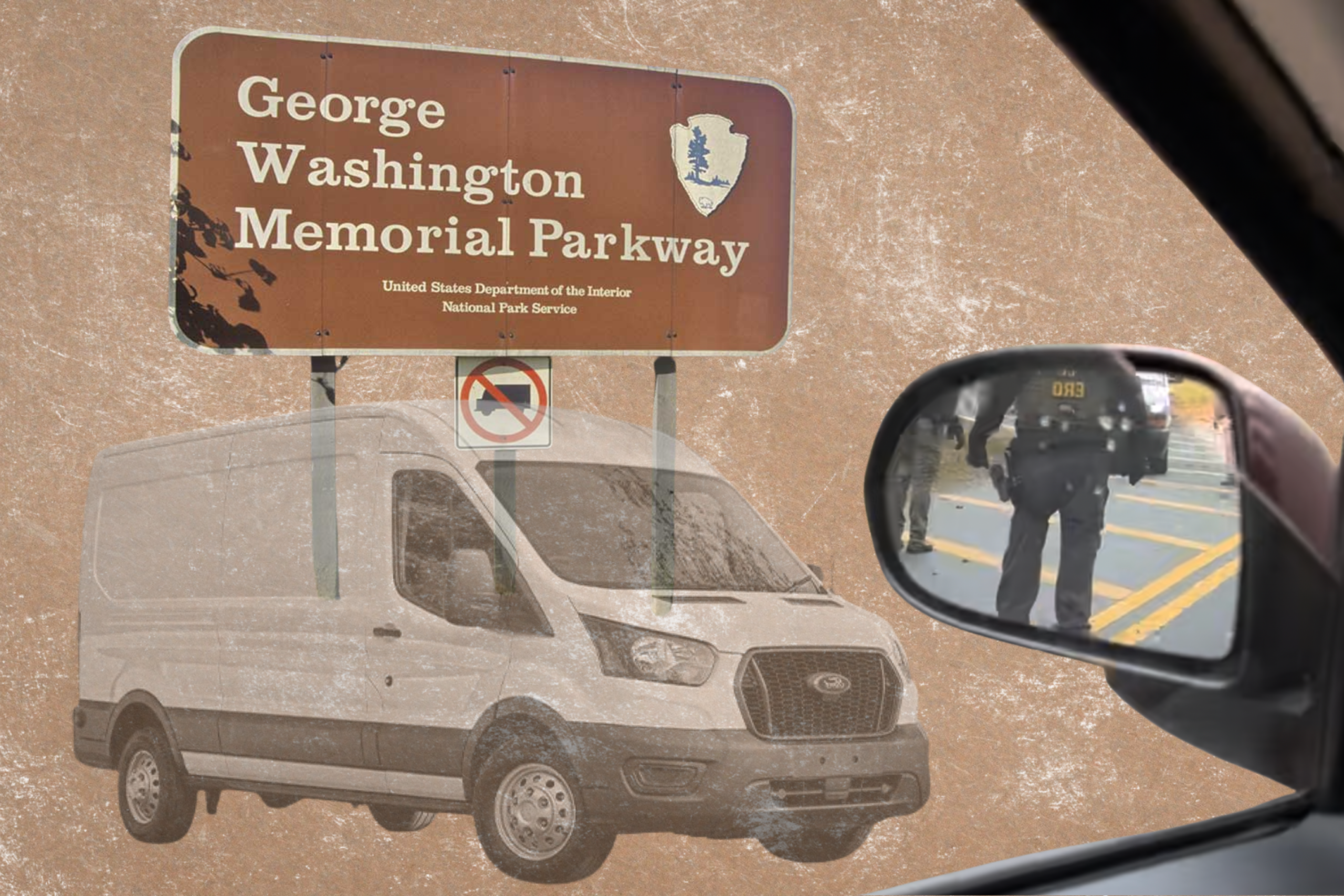
(WASHINGTON) – U.S. Park Police tailed a man while he commuted home from work – but when he stopped to get some water, ICE showed up and took him away.
A pool maintenance man got stopped by the Park Police, but it was ICE agents who scanned his driver’s license and arrested him on the spot.
And in another arrest that started with Park Police, a traffic stop turned into an immigration bust when ICE officers suddenly appeared to handcuff and detain the driver.
All of those incidents showed up in a review of court records filed between September and February that found at least ten arrests of immigrants by ICE in operations that involved the Park Police in the DC area. At least three involved arrests of workers traveling in commercial vehicles, according to the review by Capital News Service and the Howard Center for Investigative Journalism.
Advocates say that this tranche of documents reveals only a fraction of the total arrests they are witnessing on the parkways and streets patrolled by Park Police.
The court documents were filed by both plaintiffs and defendants in a class action lawsuit against the Department of Homeland Security alleging that the agency has violated federal law by making immigration arrests in D.C. without a warrant or probable cause.
The records consist of immigrants’ sworn declarations and Immigration and Customs Enforcement arrest records. Most of the accounts are filed under pseudonyms because they fear retaliation against themselves or their families.
At a time when ICE is increasingly reliant on alliances with other law enforcement agencies to fulfill the president’s immigration agenda, a partnership with the Park Police and a quirk in traffic law have streamlined efforts to take immigrants into custody.
Park Police have jurisdiction over federal land in the Washington metropolitan area, as well as parts of San Francisco and New York City. They are tasked with protecting national monuments and their surrounding areas, including federally managed roads like the Baltimore-Washington Parkway.
But the agency’s responsibilities also include working with DHS. By spring, it’s planning to add over 300 new officers in D.C., according to a spokesperson. A $70,000 signing bonus is currently advertised on the force’s website.
Advocates say that officers are using public safety laws as a pretext to make immigration arrests.
“I think it’s obvious they’re profiling,” said Austin Rose, an attorney at the Amica Center for Immigrant Rights. “They pull over a work truck, assuming it’s going to be a Latino man … That’s the basis for what they’re doing.” Rose is one of several attorneys representing plaintiffs in the lawsuit against DHS.
It’s conduct that fits a pattern of behavior by law enforcement agencies across the country, according to Naureen Shah, director of government affairs for the equality division of the American Civil Liberties Union.
“They’re simply using the legal authorities that they have, whether it be for investigating traffic violations or inspections of food and commercial vehicles inspections, to stop people and pull them out of their cars and demand to see their papers,” she said.
The Trump administration doesn’t dispute the joint operations.
“President Trump has transformed DC from a crime-ridden mess into a beautiful, clean, safe city,” said Taylor Rogers, a White House spokeswoman. “To ensure the long-term success of the operation, federal and local law enforcement officers continue to work together to keep DC safe.”
In March 2025, President Donald Trump announced in an executive order the D.C. Safe and Beautiful Task Force. Led by Stephen Miller, the president’s Homeland Security Advisor, the task force facilitates collaboration between a slew of federal agencies, including DHS and the Department of the Interior, which oversees the Park Police.
The order tasked the group with activities that align with the administration’s goals, including increasing police presence in the city and strictly enforcing public safety and immigration laws.
Back in December, the task force organized the traffic stop where the pool maintenance technician was arrested. On that day, agents from ICE, the Bureau of Alcohol, Tobacco, Firearms and Explosives, and the Diplomatic Security Service all reported to a local parkway to assist the Park Police, according to an ICE arrest record filed in the lawsuit against DHS.
When the Park Police conducted the traffic stop, an ICE officer took the opportunity to interview the man about his legal status, according to the report. In a sworn declaration filed last month, the man said the agents did not ask him about his legal status or life circumstances, in contradiction to ICE’s account.
He had no criminal record, the man said, and ICE hadn’t put a warrant out for his arrest. The interaction was the first he’d had with any law enforcement group during his 13 years living in the United States.
Still, the ICE agents snapped his driver’s license in half and told him he wasn’t allowed to be in the country.
DHS did not respond to a request for comment.
Work Vehicles Targeted
The spokesperson from the Park Police’s public information office maintained that the agency does not conduct immigration-related stops or arrests. Vehicles are stopped, she said in an emailed statement, in order to enforce traffic and public safety laws.
One such traffic law prohibits commercial vehicles, including cargo vans or trucks carrying construction materials, from driving on national parkways without a special permit.
The rule exists, the Park Police spokesperson said, because parkway features like low clearance bridges and narrower lanes make the roads unsuitable for commercial travel. Violating the law, she said, usually results in a traffic citation.
But when immigrants’ work vehicles are pulled over by Park Police at multi-agency traffic stops, court records show that some drivers have been taken into custody by Department of Homeland Security agents for immigration violations.
Park Police told one man he was not allowed to drive on a parkway that runs through Rock Creek Park in Washington because his van had a ladder on top. The car was registered in his name, his license plates and registration were current and he was driving within the speed limit, the man said in a sworn declaration. He’d previously driven on the road “nearly every day” without issue.
Still, immigration agents responded to the scene and arrested him.
While the CNS/Howard Center review found at least five arrests on Washington-area parkways, it’s hard to capture the full extent of immigration arrests that occur at Park Police initiated traffic stops because publicly available data is limited.
The Park Police’s spokesperson said that the commercial vehicle ban was in place before the D.C. Safe and Beautiful Task Force, and commercial vehicle inspections are routine. Its partner agencies, she said, do not interfere with traffic stops.
“After we have completed the reason for our stop, DHS, if present, may have follow-up questions that may result in an arrest,” she said.