
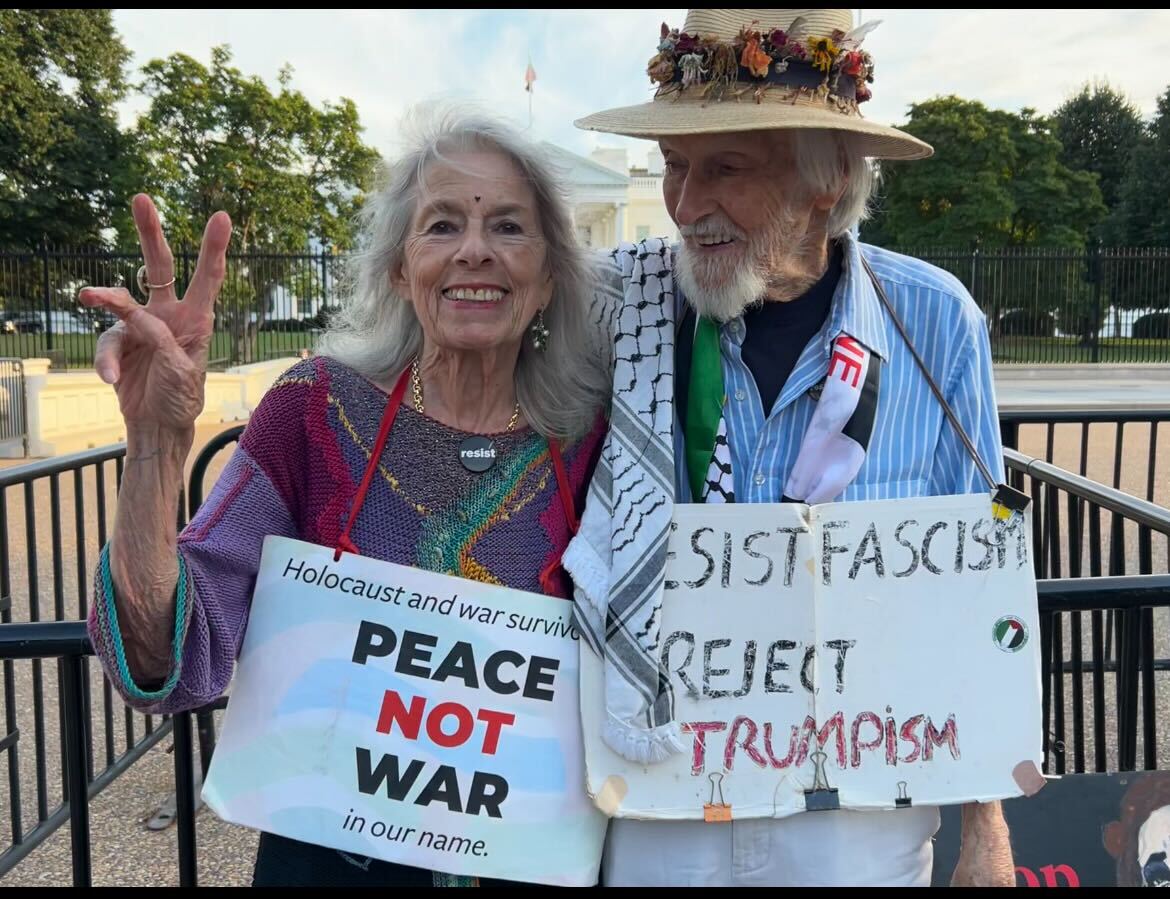
WASHINGTON, D.C.–As she sets out for the White House to protest each day, Marione Ingram begins to deliver her message almost immediately after leaving her apartment building.
Almost 90 years of age, with a shock of white hair and bright brown eyes, Ingram looks each passerby in the face. She smiles at everyone and, if they see her, she puts up two fingers in a peace sign.
“Peace and love,” she says to anyone who will meet her eyes.
Ingram, a Holocaust survivor, goes to the White House almost every day to protest, and has done so for years. She hasn’t missed a day since President Trump deployed the National Guard to police the streets of her adopted hometown.
View this post on Instagram
She says she has seen the worst that humanity has to offer. Now, with the time she has left, she wants to warn the world against authoritarianism and bigotry and cruelty.
Even though she is just one small voice in the world, she says, she hopes to get people to pay attention and join the fight.
“We always say ‘never again,” she said. “But all I’ve ever seen is again and again and again.”
This afternoon, she is running late to meet two friends. The muggy cloud of heat has broken into rain, so Ingram slips a poncho over the shiny rainbow wearable art she made herself.
Her husband of nearly 70 years, Daniel, dons a straw hat adorned with dried flowers, grabs a little umbrella, and joins her. Together they head down H Street.
A woman in business attire stands outside the World Bank Headquarters as they pass it. She opens an umbrella over her young child’s stroller. When Marione Ingram says to her, “Peace!” the woman calls out in reply.
“I’m glad someone is . . . protesting,” she says. The last word is much softer, almost impossible to hear. The current environment sometimes encourages people to whisper their dissent.
The woman looks behind and around, then up, where the rain has drip-dyed the concrete black, like the rows of small, square and darkened windows. The security camera mounted at the top sees through equally black glass.
Marione Ingram coos at the toddler in the stroller, saying hello in her light German accent.
The mother confides in Ingram, still a little wary.
“He’s the only American in this family,” she says.
Growing up as an activist
Marione Ingram was a toddler herself when she became a feminist. She heard a grown-up tell a little boy he wasn’t allowed to cry. Her mother said she thanked her for more than a year afterward for “making her a girl.” She was grateful for the freedom to cry, especially as a half-Jewish girl growing up in Hamburg, Germany, soon after the Nazis consolidated power.
She was surrounded by news of her aunts and uncles in the camps. Unlike her two younger sisters, Ingram insisted on being there while the adults talked, especially at the nighttime meetings where her parents and their colleagues spoke in urgent whispers. She was endlessly curious and certain that this grown-up talk was more important than what kids her age discussed.
She made a promise to her mother on her 8th birthday, after crawling into the earthen dugout they’d hide in at times. She saw her mother fighting tears, unable to give her daughter something to eat, much less a birthday party.
“And so I said to my mother, that if we lived and the war ended and the Germans stopped trying to kill us,” Ingram said, “then I want to become a peacemaker.”
They survived the war, but so did rampant anti-semitism. Ingram, elated to finally go to school after a childhood of make-believing her dolls were her students, was the only Jewish girl in the entire school. It was hellish. Her classmates hit her, hurled slurs and were open in their hatred of her. Every teacher marred her classwork with long red Xs and the same note at the bottom of each page: “I can’t read this.” She begged, but her father would only take her out of school under one condition.
“I want you to stand up for yourself because once you stand up for yourself, you’ll be able to stand up for others,” he told her. “And I want you to be able to stand up for others, always.”
When she moved to New York City in the 1950s, she was chasing the American dream of freedom and plenty, but it was impossible to ignore the cruelty that lived here, too. She saw Black Americans herded into ghettos, denied jobs and human rights. She saw that even children, like Emmett Till, were murdered with impunity if they stepped out of line.
Ingram, then 17, had been treated as subhuman not long ago, and says that throwing herself into the Civil Rights Movement was more a reaction than a choice. And it didn’t end with fighting for Black and Puerto Rican rights, but for every disempowered person, especially the children of war.
She taught freedom schools, joined 1963’s March on Washington, and campaigned for progressive American leaders. Then, one afternoon in 2015, the year Donald Trump announced his candidacy for president of the United States, she felt her parents take over her senses, delivering a warning.
“They were discussing Hitler’s rise to power,” she remembers. “And they kept saying, in this thing in my head, body, soul – whatever you want to call it – ‘This can’t be happening. We are too smart. We are far too intelligent. Somebody like that clown is never going to get to power.’”
Ingram says she understood then the danger facing the country. She urged people to pay attention, but no one thought Donald Trump was a serious threat.
“You know,” she says. “Nobody I knew, none of our friends for even a minute entertained the idea that he would get the nomination.”
The path to peace
The usual route is blocked off at Pennsylvania Avenue. Black crowd control gates and police cars line the street, more evidence of Trump’s tightening grip on the capital.
This week, his administration flooded the city with hundreds of law enforcement officers, including members of the FBI, the Secret Service and the military. Sirens across DC sound off constantly as Marione and Daniel Ingram skirt past the line of police.
Two more rows of crowd barriers stand between them and the White House’s own much taller gates. A few visitors pose for pictures, but the main excitement is across the street at the Peace Tent, now occupied by protesters booming upbeat music, waving colorful banners branding Trump a predator and a fascist.
Ingram stops to talk with a few of them, then walks up to the crowd control gates, greeting a nearby policeman with a peace-sign.
“Is that Trump?” A little boy gasps as he and his brother peer through the bars, eyes wide.
“Yeah,” Ingram nods. “That’s where he lives.”
One of the boys points to his mother, bouncing on the balls of his feet.
“If she sees Trump, she’ll pass out,” he says. “That’s her dream.”
“Really?” Ingram asks.
“I love him.” Their mom nods.
“Why?” Ingram says, leaning in a little more.
The boys’ mom looks at the sign around her neck warily, backing away.
“Because that’s my right,” she says. “I don’t want to get into it with you guys. You guys have your rights . . . I’m not going to have a conversation with you.”
Marione and Daniel Ingram move away from the loud music.
“It defeats the purpose,” she says. Her goal, always, is to reach people.
As more people gather, the police move the barriers, allowing access to Pennsylvania Avenue and the White House gates.
Ingram walks right up to the gates and lifts her sign from around her neck, holding it high above her head. A group of students from the University of Missouri pose for a photo right beside her, some returning her smile as she inches into the frame.
‘Oh, look at this,” their photographer says. “Got a nice sign in the background. ‘Stop genocide now.’”
They snap the picture, Ingram, sign, and all. The students are here touring DC graduate schools. One of them recognizes her, another gives her a hug, but as they start to leave, she gestures them nearer.
“Come here,” she says. “Come here. All of you.”
A fraction of the group hears her and stays behind, semi-circling Ingram as they listen.
“One of the things I would like,” she says, “is for you to become part of a global movement for peace and justice.”
She looks into each of their faces urgently, pausing to ensure they understand how important this is.
“You don’t have to tell me yes or no now,” she says. “But think about it. Talk about it amongst yourselves.
“I’m going to be 90 in November,” she continues, “so, you know, it’s not likely that I’m going to be around for another 15 years.”
A guide comes to tell the students they’ve lingered too long. They’re slow to say their goodbyes, grasping her hands, embracing and echoing “Peace and love!” back to her.
A tall young man in a navy quarter-zip leans up against the black bars, eyes locked onto the White House.
He says under his breath, “God bless Trump.”
If Ingram does hear, she pretends otherwise. She holds her sign and keeps marching.