
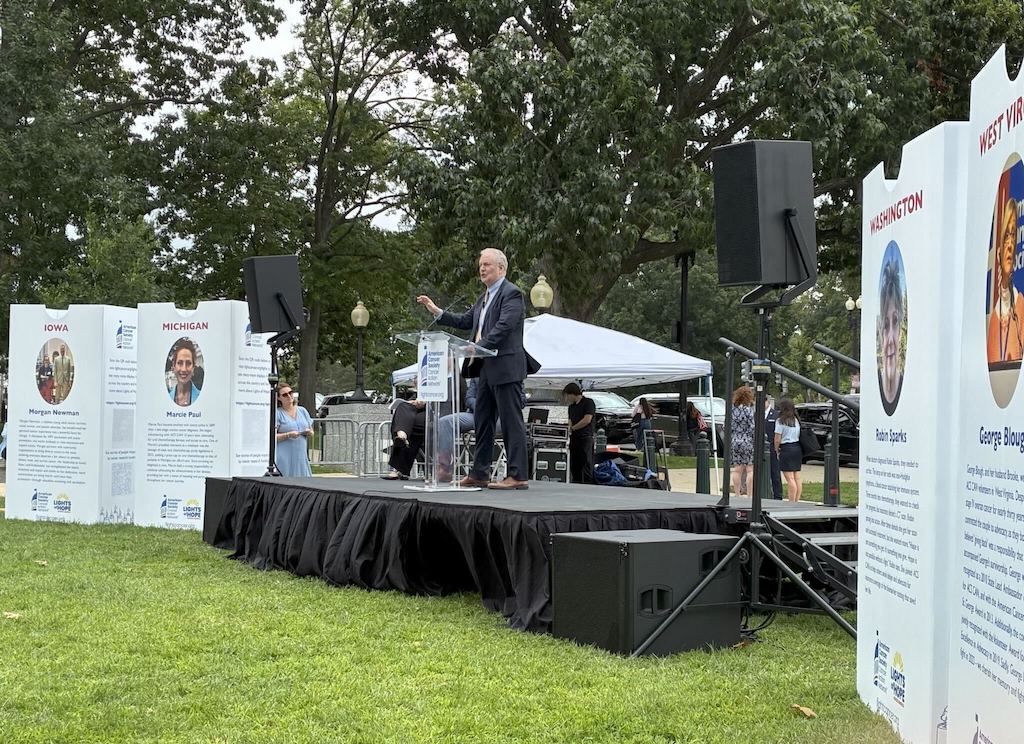
WASHINGTON – Maryland Sen. Chris Van Hollen on Tuesday slammed the Trump administration’s proposed cuts to cancer research programs, urging the president to reinstate funding for the National Institutes of Health and the NIH’s National Cancer Institute, both based in Maryland.
“This should not have to be a fight,” Van Hollen said at a Capitol Hill rally by current and former cancer patients. “It is not a partisan issue.”
Van Hollen, a Democrat, joined five other lawmakers at the American Cancer Society’s “Rally to Protect Cancer Cures,” focusing on threats of budget cuts to NIH research on cancer diagnosis and treatment.
The Trump administration’s proposed federal budget for fiscal 2026 curtails nearly 40% of the National Cancer Institute’s budget, which advocates say may put life-saving medical research at risk.
Teresa Simpson, an ovarian cancer patient from Massachusetts, told the rally: “When my current chemo is no longer effective, my next treatment will be a trial, and I pray there is one for me.”
Lawmakers said there was bipartisan support for funding cancer research.
“We need to be able to fund any good idea that may help save lives or reduce suffering, and no good idea should be left on the table for some political reason,” Van Hollen said.
“Cancer is not a red or a blue issue. This is a human issue,” said Rep. Zach Nunn, R-Iowa. “This is something we all need to be behind.”
The proposed budget cuts to the National Cancer Institute are part of a larger effort to downsize the NIH, a federal agency dedicated to medical research.
The cuts are aimed at reducing “wasteful spending, misleading information, risky research, and the promotion of dangerous ideologies that undermine public health,” according to the White House.
If enacted, President Donald Trump’s cuts would hand the NIH its lowest budget since 2008.
The National Cancer Institute, located in Bethesda, is the government’s main agency for funding cancer research.
Earlier this year, according to Van Hollen, the NCI faced staffing cuts severe enough to impact the agency’s critical research programs.
“Thousands of (NIH) researchers were laid off,” he said. “Cancer trials were interrupted and delayed as a result of what happened.”
The current iteration of a spending bill being crafted in Congress seems to reject the president’s request to cut the NCI’s budget, outlining $7.3 billion in funding, rather than the administration’s proposed $4.5 billion.
“I am pleased that both in the Senate…and the House Appropriations Committee, we have increased funding above this year’s level,” Van Hollen said.
Some lawmakers shared their personal experiences with cancer.
“I’m a 17-and-a-half-year breast cancer survivor,” said Rep. Debbie Wasserman-Schultz, D-Florida. “But I might not be standing here if not for the remarkable advancements that investment in research allowed.”
“My mother died of cancer 18 years ago,” Van Hollen said. “Her story is one of a person who benefited from the important research that had been done, in that her life was prolonged.”
“We have to send a resounding message that cancer knows no bounds,” said Rep. Terri Sewell, D-Alabama, who lost her mother to cancer. “It affects all of us.”