
Officials in Harford County recently banned the book “Flamer,” but a group of local residents is fighting back.
They have organized rallies, protests and “read-ins” ahead of every Board of Education meeting, where they gather and read aloud from the outlawed book.
“Book bans are never a good thing,” said DeLane Lewis, a local president of Together We Will, an organization devoted to social and economic justice. “You’re denying access to information, experiences, and other perspectives.”
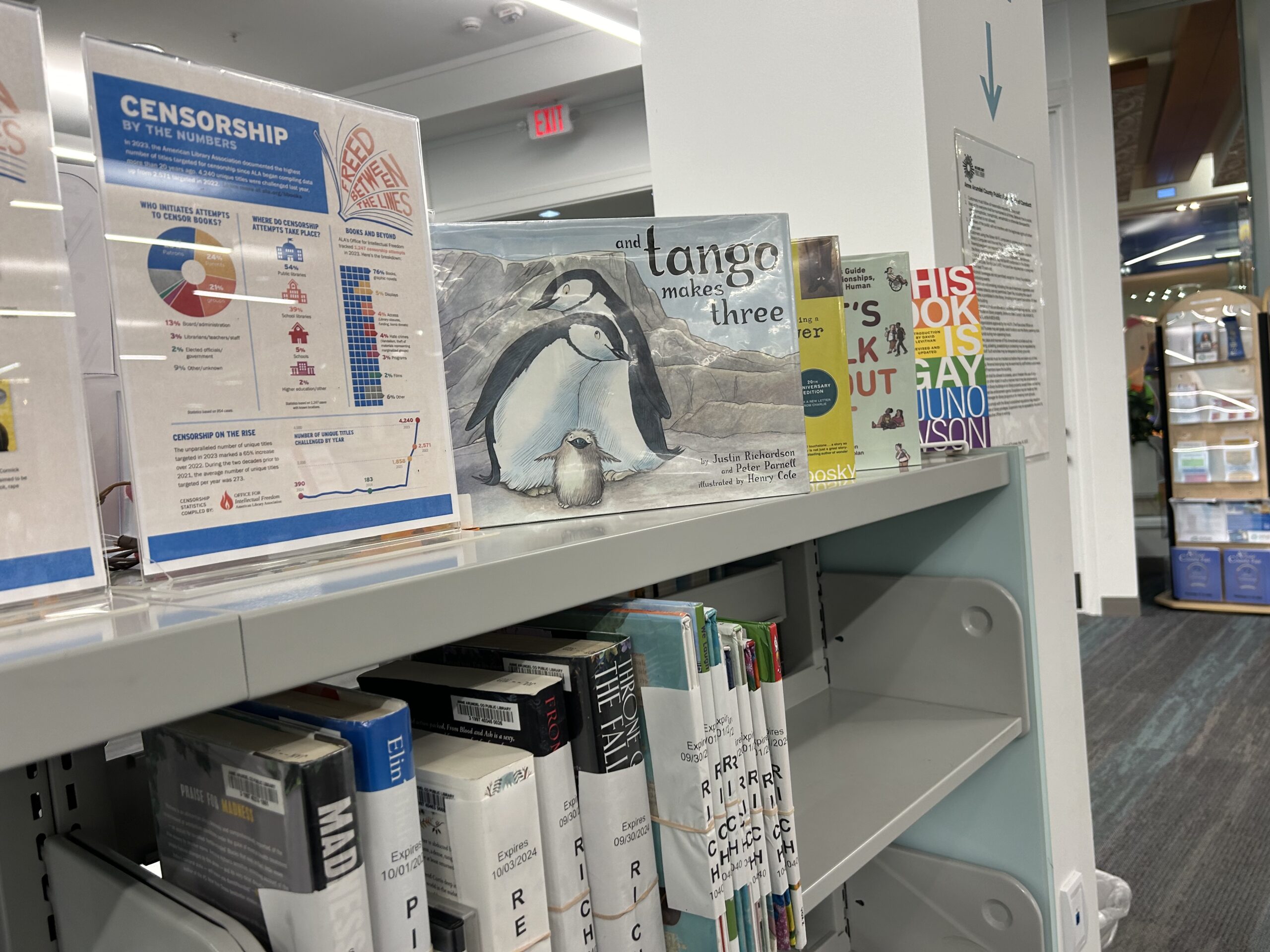
Harford County is not alone in its battle with book bans. At least three other school districts in Maryland are wrestling with the same conflict about various books, according to a 2024 PEN America list.
Earlier this year, the Maryland Library Association created the Maryland Library Helpline for library workers who face attempts to censor books and materials and harassment. The subject is getting extra attention right now, as free-speech advocates prepare to celebrate Banned Books Week starting Oct. 5.
“We’re all stronger by learning from each other and hearing other perspectives . . . and empathizing with those that we share the world with,” said David Dahl, the president of the Maryland Library Association. “Banning materials that we’re uncomfortable with is just not ultimately helping any of us.”
Maryland’s Freedom to Read Act, passed by lawmakers in 2024, requires local school systems to create a set of policies and procedures for handling objections to library materials, like books. The same year, Superintendent Sean Bulson signed Harford County’s Evaluation and Selection of School Library Materials into effect.
“Flamer” was taken off of library shelves after the Spring 2025 decision by the Board of Education, according to Harford County Public Schools. The book, written by author Mike Curato, follows a teenage boy at summer camp as he battles with his sexuality and the homophobic environment of his Catholic upbringing.
Aaron Poynton, the president of the Board of Education, defended the board’s decision to remove the book in an opinion piece in the Baltimore Sun.
“Some have called it censorship. Others have claimed it was an attack on the LGBTQ community, or that the board acted improperly,” Poynton wrote. “Let me be clear: Those claims are false.”
“Harford County Public Schools has clear procedures, developed with extensive and diverse public input, that govern how instructional and library materials are selected,” Poynton went on. “They require that content be evaluated for age appropriateness. They prohibit ‘sexual nudity,’ ‘excessive descriptions of sexual aggression’ and ‘disrespectful portrayals of characters as sexual objects.’ They also direct us to weigh profanity.”
Poynton and other members of the board have not yet responded to requests for comments from Capital News Service.
Lewis said she agrees parents should have a say in what their children read, but she thinks there’s a better solution than keeping a book away from all students.
“There is a policy in place which allows any parent to opt out of a book that they do not want their child to have access to,” said Lewis. “Now, the school board has put itself in the place of every parent and guardian in the system.”