
The D.C. Council is considering a bill to drastically limit ticket resale prices in Washington, another addition to the growing amount of legislation in the country cracking down on ticket scalping.
Councilmember Charles Allen and seven co-sponsors introduced the Resale Amendment Act in April to cap ticket resale prices at just 10% above face value, ban speculative tickets and require registration for high-volume annual resellers.
Resellers would be fined $5,000 for the first violation and $10,000 for further violations, according to the bill introduction.
If enacted into law, Washington would be the second jurisdiction after Maine to have an overall price cap that strict.
The Council held a public hearing last week to hear from local venues, fans and resale platforms.
Audrey Fix Schaefer, communications director for I.M.P., spoke at the hearing. I.M.P, which oversees the 9:30 Club, The Atlantis, The Anthem and Lincoln Theatre in Washington as well as the Merriweather Post Pavilion in Maryland, is backing the bill.
“The Resale (Amendment) Act is like the gold standard,” Fix Shaefer said in an interview. “Artists will make (Washington) a destination, and it’s going to be better for all the businesses around us, because when people go to more shows, they go to more restaurants and more bars, and it would be a real boon to the DC economy.”
Fix Shaefer presented findings of an I.M.P. report on ticket scalping on the company’s five venues at the hearing.
“We have tracked at IMP, with our four D.C. venues, 61,000 tickets resold at double face value or higher just so far this year, taking $60 billion from D.C. customers,” Fix Schaefer said last week.

Resale platforms StubHub and SeatGeek pushed back against the bill and the price claims.
Kevin Callahan, StubHub’s head of North American government relations, said at the hearing that 40% of concert tickets have been sold for under $50 and nearly 80% were priced under $100 on the platform, “demonstrating that resale does provide access, affordability and flexibility to fans across income levels.”
“We are concerned about the proposed price and fee caps as a clear example of how policies intended to help fans do actually reinforce monopoly power and undermine consumer protection in the marketplace,” Callahan said.
He argued that price caps could lead fans to buy resale tickets on illegitimate platforms, like social media, putting them more at risk of fraud.
The bill would also ban speculative tickets, or ticket listings by resellers who do not yet have the tickets in their possession.
I.M.P. reported that nearly 5,000 speculative tickets have been listed this season on StubHub for events at the Merriweather Post Pavilion.
Joe Freeman, the vice president of government relations at SeatGeek, said although the platform takes this issue seriously, it is challenging to regulate, especially for smaller venues. He said SeatGeek takes down ticket listings immediately if a venue notifies them that tickets are not on sale yet and the seller is investigated.
“We try to proactively monitor that,” Freeman said at the hearing. “We’re good, but we’re not perfect.”
Fix Shaefer, who has worked at I.M.P. for over 15 years, said ticket scalping worsened after the COVID-19 pandemic. The legal push for regulation however seemed to peak after Taylor Swift’s 2023 Eras Tour received backlash for excessively expensive ticket prices. Ticket prices were so high that some fans found it cheaper to attend a concert outside the country.
At the federal level, President Donald Trump issued an executive order in April targeting ticket scalpers who use bots to buy tickets in bulk to sell them at higher prices through the Better Online Ticket Sales (BOTS) Act.
States have generally followed suit — over 20 states have introduced or have pending legislation on event ticket sales last year. Currently, eight states have laws that specifically restrict speculative tickets, including Maryland.
In July, 2024, Maryland enacted a law that bans speculative tickets and requires resellers to disclose the total price of a ticket, which includes taxes and fees. Resellers also have to refund buyers if a ticket is counterfeit, if the event is canceled or if the ticket is different than what was advertised.
“Resale markets have put rapidly rising costs on consumers and this will help our state protect people from unnecessary price hikes,” Gov. Wes Moore said in a statement last year.
But while most states have regulations against ticket resales, like price disclosure, 10 state laws don’t account for tickets sold online. Washington law only prevents ticket scalping on public spaces, like sidewalks. Ten state laws don’t include concert tickets in their legislation, instead restricting sport or college event ticket resales.
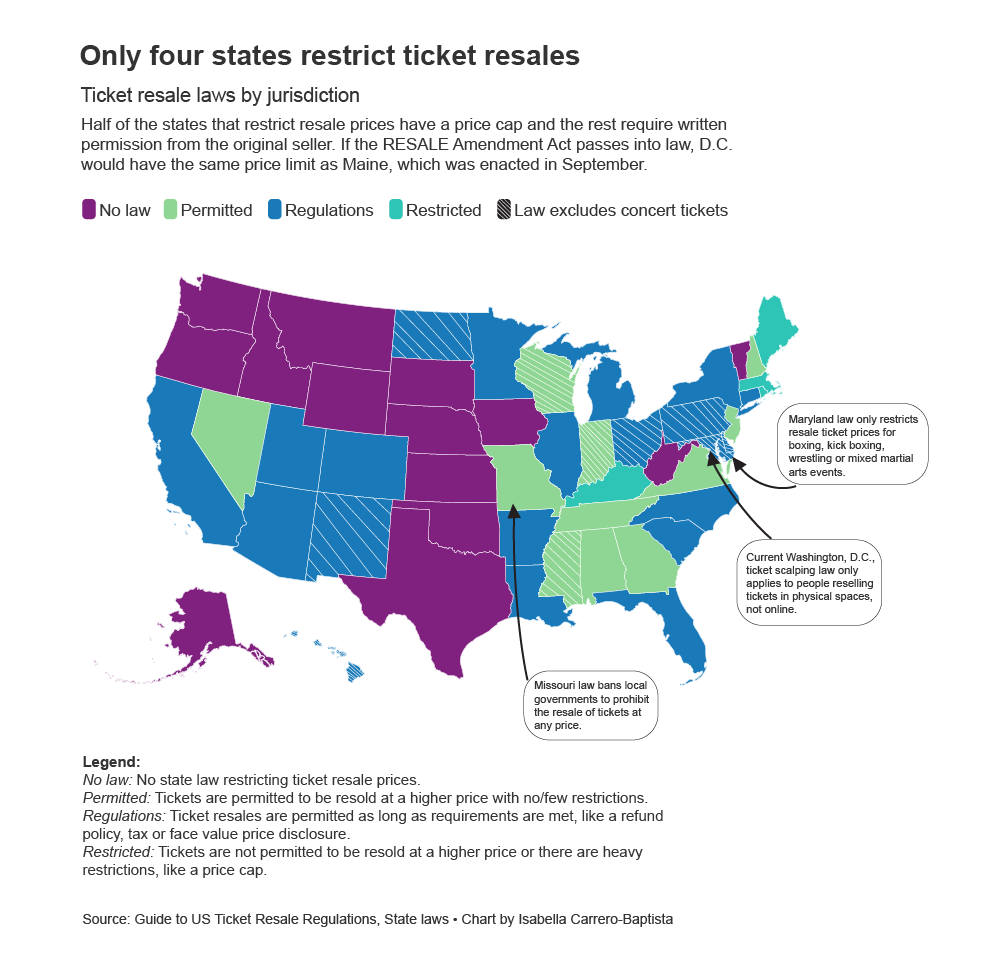
The council has not announced a timeline for a vote on the bill.
You must be logged in to post a comment.