
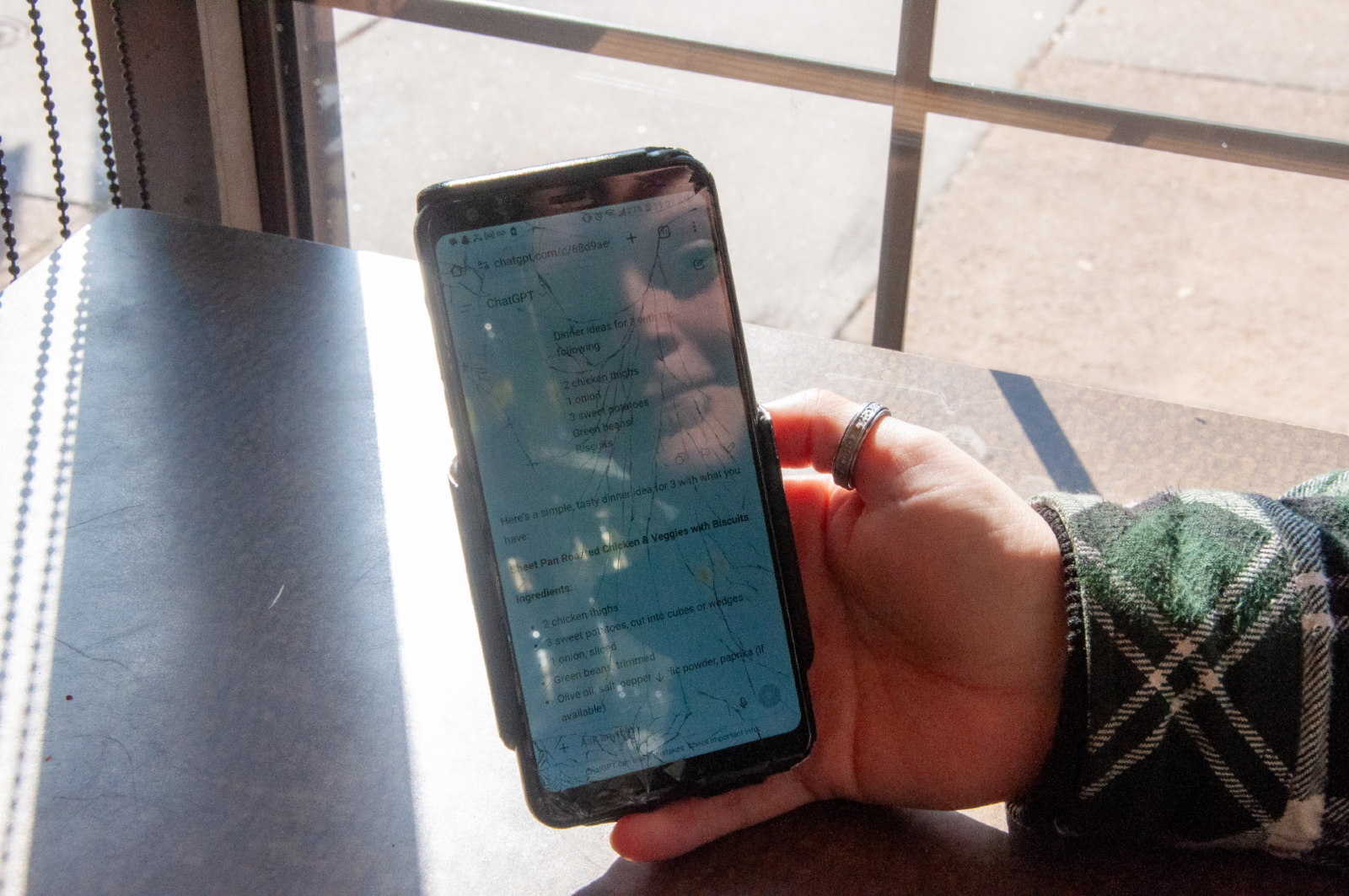
BALTIMORE–Dinner ideas for three with the following: one onion, three sweet potatoes, green beans, biscuits.
That is one of the most recent conversations Jenna Crocker has had with ChatGPT, asking for meals she can make with the ingredients left in her fridge, with enough to feed herself, her fiancé and her 13-year-old daughter.
Crocker, a 37-year-old resident of Cherry Hill, in south Baltimore, has to get creative to make ends meet. She’s been enrolled in the nutrition assistance program since March to supplement her minimum wage job at a local café. But the assistance program isn’t always reliable.
“I’m sure most single parents would rather be able to work and live comfortably and be there for their kids,” Crocker said. “We have to choose whether we have a roof over our head or we rely on the school to help transform our child into a successful human being.”
Over the past few weeks, uncertainty has circled as funding was halted for federal programs like SNAP that millions of Americans rely on for their basic needs.
It’s been a frenzied month. SNAP benefits were set to expire on Nov. 1. A federal judge ordered the administration to make full food benefit payments, but the president pushed back, writing that the benefits “will be given only when the Radical Left Democrats open up government” on his social media platform.
Some Americans continued to get SNAP benefits through state funding, including Marylanders, as Gov. Wes Moore announced a state of emergency. After a small group of Democratic senators voted Monday night to approve a funding measure to reopen the government, Trump signed a funding package to end the longest shutdown in American history.
But for the 42 million Americans who receive monthly SNAP benefits, stability is less clear.
“We’re still very concerned on a number of levels,” said Craig Rice, the CEO of Manna Food Center, a Montgomery County-based food assistance organization. “We’re still not sure how much money is being deposited on individuals’ cards, and from whom.”
Like many other SNAP recipients, Crocker is left with nothing but confusion about if and when she’ll receive this month’s benefits.
After conferring with ChatGPT, she was able to find two remaining chicken thighs, throw the sweet potatoes and onions into the air fryer and produce a full meal containing all of the recommended nutritional aspects (carbohydrates, protein, fat).
On the eighth of every month, Crocker typically receives $536 on her benefit card, the system used to distribute and access SNAP benefits. But just Tuesday, $355 was loaded into her account, under 70% of the normal balance. She could either take a 15-minute bus ride to the nearest Harris Teeter or drive 20 minutes to ALDI.
But driving to the grocery store is a luxury. For a few days per month, if there’s extra cash, Crocker and her fiancé are able to rent a car, allowing them to drive to the grocery store, food bank and laundromat.
During the weeks when Crocker relies solely on public transportation, she buys groceries at Harris Teeter and Dollar Tree.
“If I have to take a bus, I usually go to Harris Teeter because [their store] brand is cheap … and allows me to make better meals. When food stamps get lower towards the end, it’s easier to make meals at Dollar Tree,” Crocker said.
To get to ALDI via public transportation, Crocker would have to take two separate buses, taking her nearly an hour just to arrive at the store.
Even as she is scraping by to make sure she can feed herself and her daughter, Crocker has taken up community advocacy and activism in Cherry Hill, especially with living across the street from two abandoned former school buildings.
As the events coordinator for We the People United for Change, a Baltimore nonprofit, she submitted a proposal to develop the vacant lots into a community resource hub, adult education center and affordable housing, said Crocker.
Opportunities for higher education are a top priority for Crocker. She recalled visiting the Cherry Hill library where she witnessed an older gentleman struggling with an online application.
“He didn’t even know how to use a [computer] mouse,” Crocker said. “Why aren’t there resources for [community members] to want to better themselves? People need skills. If we do the adult education route, we can have a Vo-Tech type of school.”
Crocker also wanted to implement a community fridge in Cherry Hill, but said the idea was rejected by community leaders.
The idea, Crocker said, was shut down because it would attract “homeless people and drug addicts.” But those people are already there – and they’re still hungry.
“At the end of the day, any type of community organization or group should have the interest of the community at hand first,” Crocker said. “Having a refrigerator would help … solve a lot of the food insecurities.”
Crocker feels a sense of urgency to show up for her community and wants to echo that message back to them.
“If my mom taught me anything, it’s work hard for what you have, and give back [to the community],” Crocker said.
Over the past 15 years, Crocker has worked overtime, participated in night school and had limited time at home – all common struggles of a single mom.
“I hope that my kids saw what I was doing wasn’t to not be there for them,” she said, “but to provide a life for them so they didn’t have to lack anything.”
