
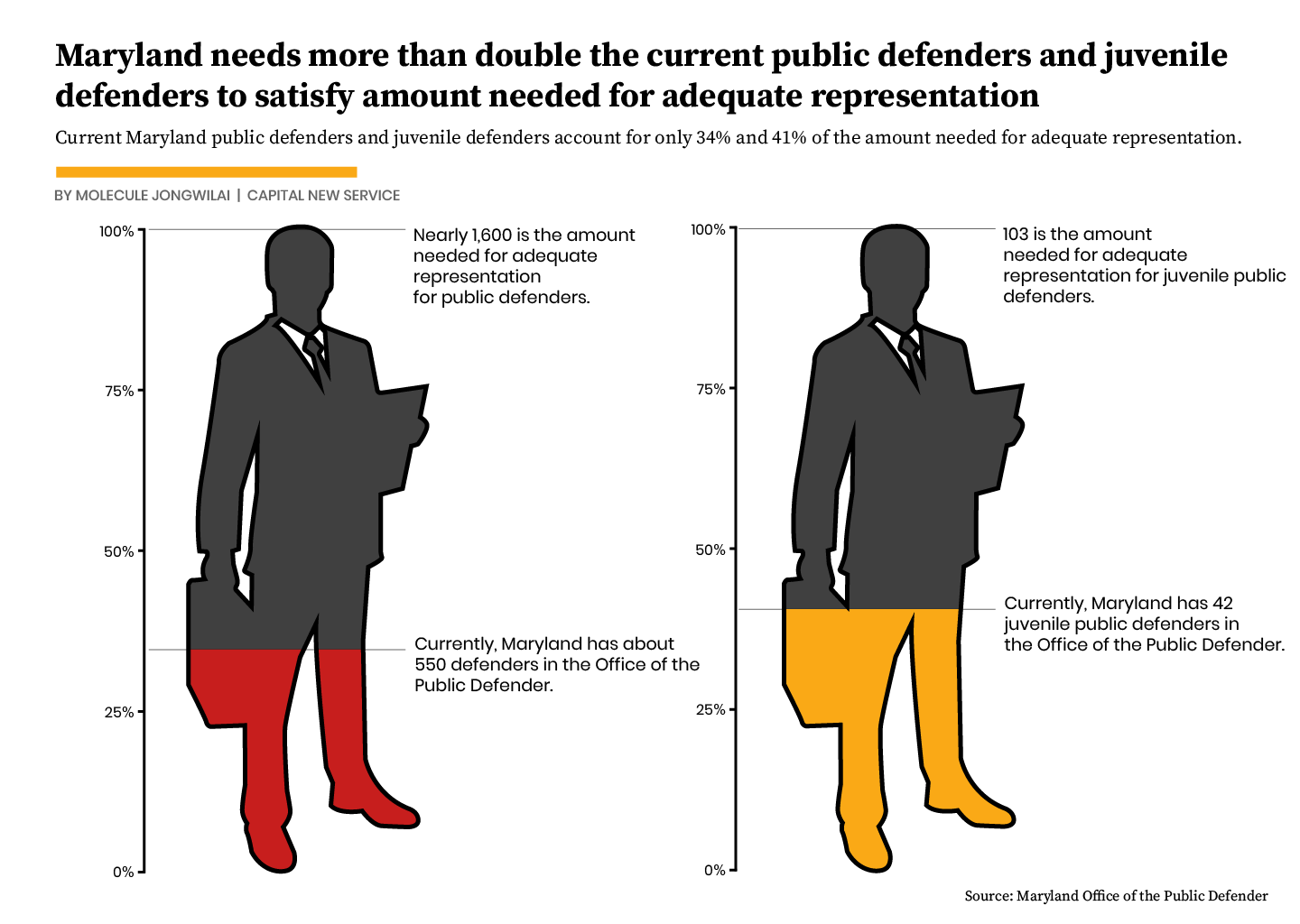
The Maryland public defender’s office is pushing for more funding and resources to hire more attorneys, arguing that they have less than a third of the lawyers needed for adequate representation as outlined by the National Workload Standards.
There has been a shortage since the mid-1970s, according to Maryland Public Defender Natasha Dartigue, but it has reached a critical stage lately.
“We have hit a breaking point,” Dartigue told Capital News Service. “The gap between what we need and what we have is accelerating. Think of it like deferred maintenance on a bridge where the underlying weakness may have been there for years, but there comes a point where the stress exceeds the structure’s capacity.”
The push for more funds comes at a time of fiscal hardship for the Maryland state government, which funds the office.
In the Fiscal Year 2026 Budget, more than 80% of the Office of the Public Defender’s budget, which totals over 132 million, was allocated for salaries, wages, and fringe benefits, according to Dartigue. The number of positions for which money is allocated is approximately 1,093.
The Maryland Office of the Public Defender needs to more than triple its attorney count to meet minimums for adequate representation, growing from around 550 attorneys to nearly 1,600, Dartigue wrote.
These minimums, outlined in the 2023 National Public Defense Workload Study conducted by the RAND Corporation, also indicate that the OPD needs more juvenile defenders, an increase from 42 to 103 attorneys, according to Dartigue.
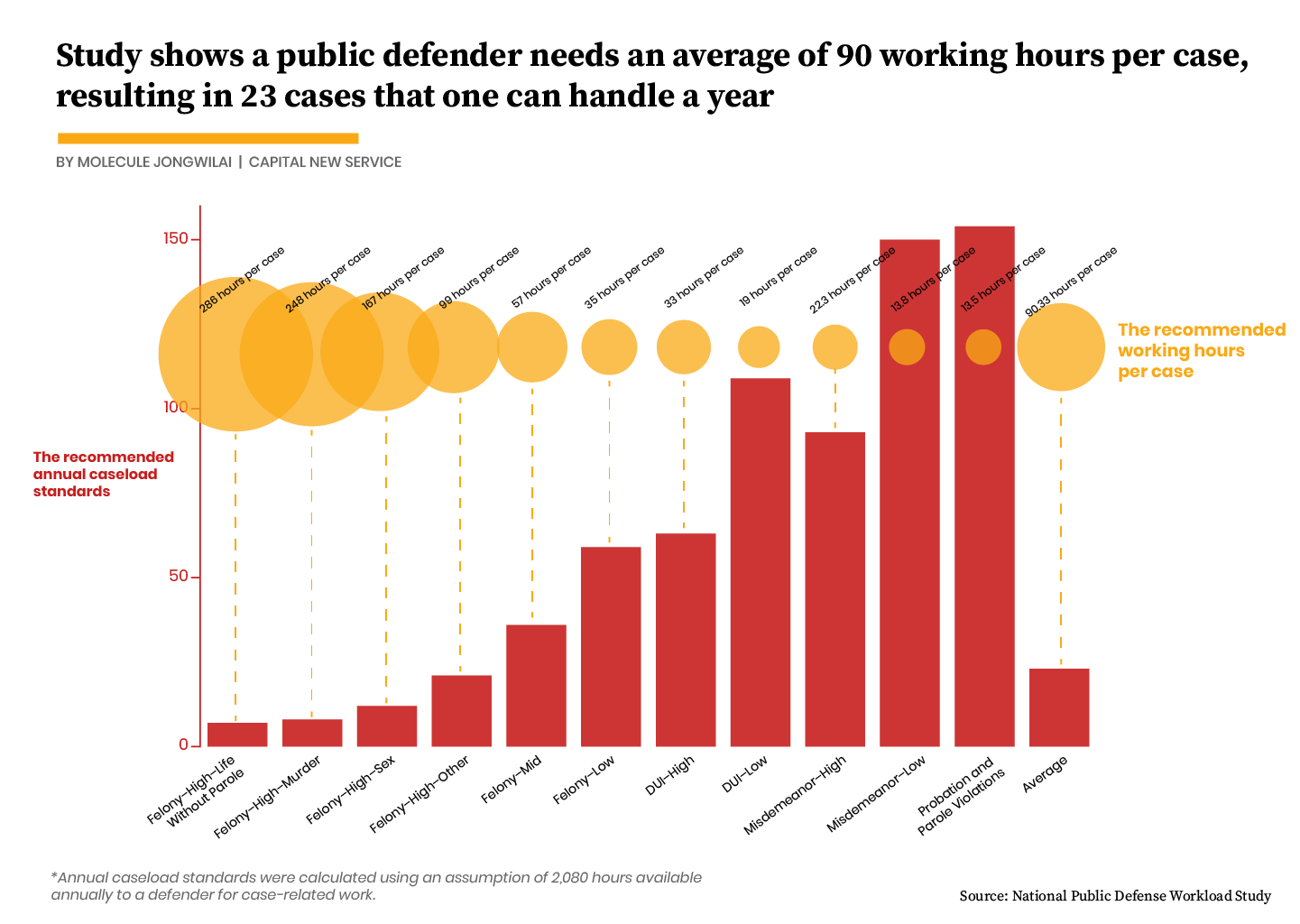
The study outlines several hourly recommendations for effective representation, ranging from 286 hours for a felony-life-without-parole case to 13.5 hours for a probation or parole violation. Based on the study’s assumption that an attorney has 2,086 hours a year for case-related work, a public defender could effectively represent 7 felony life-without-parole cases or 154 probation or parole violations annually.
“I think there is a real failure of people to recognize that the right to have not just an attorney, but an attorney who has time to spend time on your case, to develop a full idea of what happened, as well as develop alternatives to incarceration,” said David Jaros, the faculty director of the Center for Criminal Justice Reform and a professor of law at the University of Baltimore School of Law.
Maryland public defenders earn less on average than their counterparts at the attorney general’s office, according to Dartigue.
The resulting high turnover and vacancy rates cause current staff to be overworked, she said.
There is a current hiring freeze for state agencies, according to Dartigue.
“While case loads continue to rise, they’re not able to respond with hiring more attorneys,” Jaros said of how the freeze affects the Office of the Public Defender.
Amidst the lower pay, public defenders take care of two to three times the recommended amount of cases and make other sacrifices in their personal lives, Dartigue told CNS.
“Belief in the mission does not pay student loans,” said Dartigue.
Katie Kronick, an assistant law professor and director of the Criminal Defense and Advocacy Clinic at the University of Baltimore School of Law, said that a case overload means public defenders are less able to fulfill their constitutional duties, like filing motions, meeting with clients, and investigating, increasing the risk of wrongful conviction.
Jaros said that the time spent on each case is crucial.
“You can imagine that if it was your liberty on the line, if you were awaiting trial, perhaps even in jail, … anything that slowed down the process or prevented your attorney from spending time on your case would be devastating, and then this has a ripple effect across entire communities,” Jaros said.
Dartigue said that there is no full solution to the crisis that does not involve more attorneys and other staff. Adequate funding is necessary.
Kronick also told CNS that Maryland’s state leaders need to focus on investing in public defense.
“I’ve been really impressed by the public defenders whom I’ve seen in Maryland,” she said. “They’re working, they care, they’re smart, effective, but they can only be as effective as they have the time to do so. Really making sure that the spending is there for the office to be adequately staffed is crucial.”

You must be logged in to post a comment.