

LONDON – David Watson was a star of English football in the 1970s and ’80s. Now, he can’t remember how to write an anniversary card to his wife.
Penny Watson, the wife of the former professional soccer player, has taken the case to the British courts, arguing that the head injuries her husband suffered as a player are responsible for his health spiral. She is working to gain recognition for her husband’s sacrifices to the sport – and to support other former players and their families as they watched their loved ones suffer through neurodegenerative diseases.
“We can’t do much about those who have [dementia] now, other than care for them and make life easier for them and their families,” Watson said. “We are the ones who carry the brunt of it.”
Both the United States’ Major League Soccer (MLS) and England’s Premier League have adopted concussion protocols within the last decade to better protect their players. Yet despite having access to the same research, the leagues take divergent approaches to player safety due to differences in culture surrounding the sport.
The two countries call the sport different names: the U.S. refers to the sport as soccer, while the U.K., along with most other countries, calls it football. The sport played by the National Football League — called “American football” outside the U.S. — helped pioneer sport-related concussion research.
A concussion is a violent shaking of the head that causes a wide variety of symptoms, ranging from headaches to brain fog to loss of consciousness. Repeated concussions, especially those that occur before full recovery, significantly increase the risk of long-term neurological conditions like dementia and chronic traumatic encephalopathy.
In soccer, concussions are most often caused by collisions between players – typically with players running towards each other at full force.
The first sets of concussion protocols for both MLS and Premier League were introduced at the beginning of the 2014-15 season. But in 1980, Watson was able to return to play even after he was knocked unconscious.
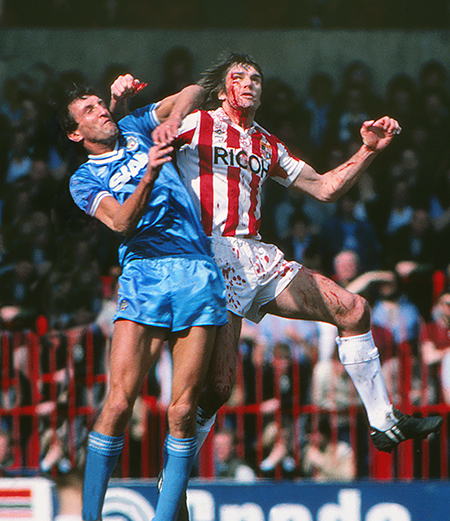
“After he was revived, he was allowed to carry on playing,” said Gemma Jordan, the daughter of David and Penny Watson. “All the other players [went] over to him to congratulate him for the goal he’d just scored. [But] he had no idea what was going on or what had just happened.”
Both the United States and England have increased precautions over the past four decades. If even a single sign of a suspected concussion is observed, players are required to go through extensive protocols in most major soccer leagues, including the MLS and the Premier League.
Dr. Robert Cantu, the co-founder of Boston University’s CTE Center and medical director of the Concussion and CTE Foundation, created the first Return-to-Play protocols in 1986 – 13 years after Watson’s notorious match.
When Cantu entered sports neurology in the early 1970s, no research had been done on concussions in sports. Most of the research revolved around car accidents and falls, he said.
“The sideline physicians were almost all orthopedic surgeons who really didn’t care much about concussions,” Cantu said. “[They] cared mostly about what they knew most about, which are broken bones and orthopedic injuries.”
MLS concussion guidelines are easy to locate. They are the first hit on a Google search and include a visual diagram for in-game use.
The Premier League guidelines aren’t as simple to find. They are not searchable but are located in the league’s handbook, which is updated annually. Its full concussion protocol starts on page 581.
A relatively new guideline for both leagues is a position in which a medical staffer must continuously watch live video feeds of the matches in order to catch potential injuries, easy to miss by the naked eye. But the background of the position differs between the leagues.
In MLS, the spotter is hired by the league, independent of the teams. But in the Premier League, a member of each club’s medical staff is nominated to the same role.
“Both approaches have different strengths,” said Dr. Adam White, the director of brain health for the Professional Footballers’ Association, the players’ union for professional soccer players in England and Wales.
Hiring an independent spotter could eliminate certain pressures and team biases. But having a spotter who knows the players personally makes it easier to recognize subtle signs of concussions, White explained.
The medical requirements for MLS and the Premier League follow similar guidelines, but the information is presented in very different ways.
The MLS guidelines are easy to understand for medical professionals and fans alike. The Premier League protocols resemble a legal document, appearing like it was written by lawyers aiming to avoid being sued.
“The Premier League has got so many rules,” White said. Having all the rules in one place, rather than different sets of protocols, makes it easier for the League to “govern their game.”
As both protocols are updated annually, players’ mindsets also continue to shift – but more slowly.
“I think we were a lot more naive when we started,” said Don Hutchison, a former professional footballer in the U.K. and a current pundit and commentator for ESPN. “I’m from the old school [of thought] where…I don’t want the game to be sanitized too much.”
In the ’90s, when Hutchison started his career, there was minimal understanding — and attention paid to — the signs of concussions and long-term risks associated with repeated head trauma.
Even with education, football culture makes it hard for players to fully understand how dangerous a head injury can be.
“The culture of sport definitely trains our athletes to play through pain, that kind of ‘warrior’ mentality,” White said. “Unfortunately, we’re always going to be up against that.”
Training players early on the dangers of head injuries can be beneficial for shifting mindsets, White said. Both countries have introduced preventative measures to protect youth.
U.S. Youth Soccer clearly defined no heading the ball for ages 10 and under, starting in 2015. The move is gradually introduced and taught from the age of 11 until 13, when finally players are allowed to head at full force. In the U.K., heading is gradually being phased out of youth leagues between the ages of seven and 11. By 2027, heading will officially be introduced at age 12.
White worries that a lack of seriousness towards youth head injuries is setting the U.K. back. He said young people are more likely to receive “substandard care” for minor concussions, which could age into greater problems in the future.
“For people with mild traumatic brain injuries, it still has this overall perception that they’re insignificant and they’re not really important,” White said.
That attitude from doctors also diminishes the seriousness of the injury to players. In the U.S., Cantu said it’s “no question” that players are becoming more aware of the risks to the head. In the U.K., though, there’s a debate about whether players are getting the message.
Part of the issue is age, White said. Some players have not reached full brain development and therefore don’t understand risk to its full extent. The Premier League also has an influx of players from other countries in Africa and Asia, where head injuries aren’t viewed as a significant concern.
The Premier League mandates annual brain health education sessions through the Players’ Union to reinforce the risks head injuries can have to players. The league also limits heading in practices to no more than 10 “higher-force” headers per week, defining it as passes longer than 35 meters or from corner kicks.
But some players want to focus on the old game and set aside the new information.
In a 2015 study, 64% of players at an English Football League Championship club said they would continue to play despite having a concussion. Players from a Premier League club study in 2025 were more concerned about hip and knee injuries; they did not identify head injuries as a main issue.
While some players showed concern about the long-term outcomes of heading, most thought the new guidelines constricted their career growth.
“Because it’s not necessarily an injury you can see and feel and recognize, it’s not a problem until you get a bad one,” White said. “Actually getting players to connect and conceptualize, and understand that can also be a challenge.”
Premier League and Champions League players did identify the dangers in sports like football and rugby, where there is more direct bodily contact. Translating it to their own sport is the next step.
While a serious soccer head injury ruined the life she knew, Penny Watson still doesn’t want heading fully removed from the sport. Like many, she believes it’s part of the integrity of the game.
But she is ready to see safety put first.
“Some people have asked for no heading at all, [but] that would be a completely different game,” Watson said. “[But they must] figure out how to perfect the technique without having to constantly be putting your head and brain through that [trauma].”

You must be logged in to post a comment.