
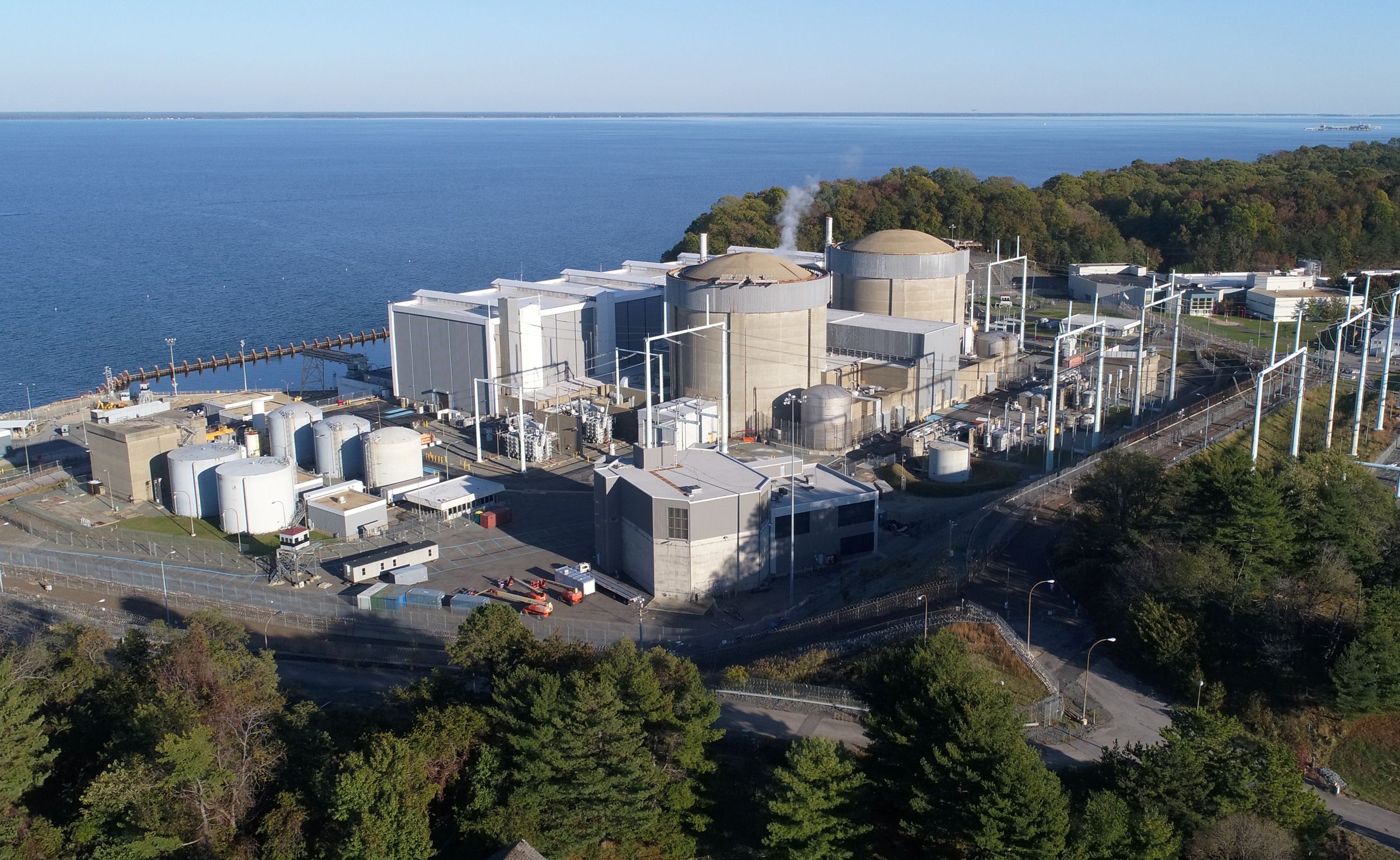
LUSBY, Md. — Steam drifts above two steel-lined concrete domes at Calvert Cliffs, a 50-year-old landmark for carbon-free energy perched along the Chesapeake Bay.
Those two domes, along with an adjoining building, make up the Calvert Cliffs Clean Energy Center, a familiar sight to locals and Maryland’s main producer of energy.
Thanks to a recent $100 million upgrade, the nuclear power plant can produce 10% more energy than it once did — “more than all the existing wind and solar generation in Maryland,” said Fabion Seaton, senior advocacy manager for Constellation Energy Group, which manages the plant.
In early November, Constellation proposed a further expansion. But that plan, like every proposed nuclear expansion nationwide, faces a daunting question: Just how green is nuclear energy?
The growth plans at Calvert Cliffs point to nuclear energy’s ability to strengthen the nation’s clean-energy supply with steady, carbon-free power.
“If America is to achieve its 80% reduction goal in greenhouse gas emissions by 2050, nuclear energy needs to be part of the solution,” said Brandy Donaldson, manager of Generation Communications-East for Constellation, which is also working to reopen the long-shuttered and once-troubled Three Mile Island nuclear facility in Pennsylvania.
But its efforts to grow the industry continue to collide with environmental concerns. Much of that skepticism stems from history, be it the partial meltdown at Three Mile Island in 1979, the reactor explosion at the Chernobyl Nuclear Power Plant in the then-Soviet Union in 1986 or the earthquake-prompted accident at the nuclear facility in Fukushima, Japan, in 2011.
“Whenever anybody says to me, personally, nuclear power is green energy, what I want to say to them is ‘I wonder if the folks that lived near Chernobyl and Fukushima would agree with you,’” said Sandra Gwynn, group chair of the Southern Maryland Group of the Sierra Club, which is part of the Maryland chapter.
Calvert Cliffs’ future
Calvert Cliffs is expanding, but not as much as once proposed.
In 2007, plans were underway for Calvert Cliffs to expand with a third reactor. But by 2015, the proposal was shelved, derailed by the surge of cheap natural gas, escalating construction costs and years of regulatory slowdown.
Attention shifted toward sustaining and upgrading the two existing reactors rather than building a new one. That led to last spring’s “refueling outage,” the plant’s most significant overhaul in a decade.
More than 2,000 contract employees arrived in southern Calvert County to take on a dense schedule of inspections and maintenance — from replacing aging overhaul pumps, motors, valves and control rods to repairing electrical systems that have been operating since the plant began producing power.
Workers also completed one of the most complex electrical projects at the site in years: the full refurbishment of the plant’s 13-kilovolt transformer, a central component that allows Calvert Cliffs to push large volumes of electricity onto the grid, Donaldson said.
The overhaul included modernization work typically done during major life-extension efforts at nuclear plants, such as digital upgrades to control equipment that replace 1970s systems. The improvements reduce the risk of equipment failures and give operators more precise data on plant conditions.
With the improvements in place, the facility can power another 150,000 to 200,000 homes, Kathryn Maney, president and CEO of the Calvert County Chamber of Commerce, told CNS in an email.
Carbon-free energy
The increased output at Calvert Cliffs comes with no added carbon emissions and no additional land footprint. That’s one reason climate researchers often favor extending the life of existing nuclear units.
“Existing plants should be kept open if possible — if they’re managed well,” said Joseph Romm, a senior research fellow at the University of Pennsylvania who advocates cutting carbon emissions and expanding clean energy.
Experts also highlight that nuclear energy is carbon-free energy.
“Nuclear reactors produce electricity, they don’t produce even one atom, one molecule of carbon dioxide,” said Mohamad Al-Sheikhly, a nuclear and radiation researcher and professor at the University of Maryland. “It’s a very promising technology to produce energy without increasing carbon dioxide.”
In climate terms, that matters. Each year, Calvert Cliffs prevents millions of tons of carbon emissions — the equivalent to taking 80,000 cars off the road, according to Nuclear Powers Maryland, an advocacy group.
As electricity demand rises — driven by data centers, electric vehicles, electrified heating and population growth — Constellation has proposed another expansion that would produce 5,800 megawatts of new power at Calvert Cliffs.
Meanwhile, the plant will remain a significant economic contributor to Southern Maryland. Calvert Cliffs’ operations employ more than 800 employees and contribute to $23 million a year in local property taxes.
“In general, nuclear plants employ more people per megawatt than any other type of power source,” Donaldson said.
Costly – at first
Modernizing and expanding a nuclear power plant like Calvert Cliffs is far less costly and time-consuming than adding a reactor or building an entirely new facility. According to federal data, only two new nuclear reactors have been built in the U.S. since the mid-1990s, and experts said cost is the big reason why.
In an analysis published last year, Michael Purtill, an analyst with the Harding Loevner investment firm, noted the cost to build a new nuclear facility amounts to more than $7,000 per kilowatt hour of energy produced. In contrast, building a new coal-fired power plant costs $4,000 per kilowatt hour, solar costs less than $2,000 and a new natural gas-fired facility costs about $1,000.
“The problem with nuclear energy today isn’t safety,” Purtill wrote. “It’s cost and time, specifically the upfront costs to build a new plant and the years, or decades, that it takes to get a new plant up and running.”
Al-Sheikhly noted, though, that even if the cost of expanding or building a nuclear power plant is high, the cost of production is not.
“[Nuclear power plants] are producing at 3 cents on every 1 kilowatt of electricity on the wire. Three cents, for goodness sake. Three cents. I mean, it’s so cheap,” he said. “When you build them, you spend a lot of money — no doubt.”
Safe despite accidents
Al-Sheikhly stressed that despite a handful of headline-grabbing accidents, nuclear power actually appears safer than many other forms of energy.
Research conducted in 2007 and updated in 2018, which was published by Our World in Data, showed nuclear energy produces vast quantities of electricity while causing a minuscule number of deaths compared to coal.
Accidents have served as lessons for the nuclear sector, said Doug Vine, the director of energy analysis at the Center for Climate and Energy Solutions.
“It’s largely demonstrated itself to be a very safe source of electricity with the exception of a few examples,” Vine said. “We’ve learned a lot from Three Mile Island, from Chernobyl, from Fukushima, and those safety enhancements have all been incorporated.”
In addition, people who live near nuclear plants don’t tend to criticize them, noted Ann Bisconti, president of Bisconti Research, who has been researching public opinion about nuclear energy for 42 years.
“We have found remarkably high support for the plants,” she said. “Ninety-one percent of nuclear power plant neighbors across the nation, that’s an average of all the sites, have a favorable impression of the plant. … So, there’s a really strong sense of ownership and belonging that the community really has something that is theirs.”
Environmental concerns
Not everyone is convinced, though, that nuclear energy is safe.
Living just 6 miles from Calvert Cliffs, Gwynn said the risk feels real.
“I think frequently about what would happen if there was a significant release of radioactive material,” she said. “I can’t imagine the nightmare of trying to evacuate the area.”
A study published last month in the academic journal Nature indicated that thanks to the low levels of radiation emitted by nuclear facilities, older people living near them could die of cancer at higher rates.
“These results indicate a spatial association between residential proximity to nuclear power plants and cancer mortality, ” said the study, which was conducted by researchers at Harvard University’s T.H. Chan School of Public Health.
Other scientists still stress the risk of nuclear meltdown: accidents where huge amounts of radiation could be released. Mark Z. Jacobson, a professor of civil and environmental engineering and director of the atmosphere/energy program at Stanford University, last year published an essay on the One Earth website noting that 1.5% of all nuclear reactors nationwide have experienced meltdowns of some kind.
“The nuclear industry has proposed new reactor designs that they suggest are safer,” he wrote in the essay, where he argued that nuclear energy is not the answer to climate change. “However, these designs are generally untested, and there is no guarantee that the reactors will be designed, built and operated correctly or that a natural disaster or act of terrorism, such as an airplane flown into a reactor, will not cause the reactor to fail, resulting in a major disaster.”
Nuclear waste
There is one other issue no nuclear plant can escape: radioactive waste.
The nation’s long-planned permanent nuclear waste repository at Yucca Mountain in southern Nevada was effectively abandoned in 2010 after years of local opposition from state officials and residents, who raised concerns about geology, safety, transportation risks and capacity.
At Calvert Cliffs, spent fuel is stored on-site in dry casks — a monitored, interim solution licensed through 2052, but not a permanent waste disposal site, according to the Nuclear Regulatory Commission.
“And that’s just a risk,” Romm said, referring to on-site nuclear waste storage. “If there was some terrible storm, that could be a complete disaster… or some flood. So, I think there’s a lot of risks and no obvious benefit.”
Bisconti said the public perception of nuclear waste is shaped more by imagery than reality.
“The used nuclear fuel is held safely on site within containers that are extraordinarily robust,” she said. “[People imagine] barrels with skull and crossbones … and then we show them pictures of what a good container actually looks like, and they’re quite surprised and very happy.”
Nuclear waste remains an issue, though, for the industry’s critics. Gwynn said the Sierra Club hopes for a future based on renewable wind or solar energy, not on long-term reliance on nuclear power.
“They are in favor of renewable energy that’s as clean as possible. And that’s solar power, wind power — things like that,” Gwynn said.
U.S. is falling behind
While debates about nuclear energy continue across the U.S., Al-Sheikhly said the rest of the world isn’t waiting.
Globally, there are 440 nuclear reactors operating in 31 countries, with about 63 under construction. Virtually no new reactors are under construction domestically. In contrast, China leads global expansion, while operating 57 reactors and constructing 29 more.
Other countries actively building reactors include India, Russia and South Korea.
This global momentum contrasts with the U.S., where new nuclear power plants face political, financial and regulatory hurdles. Many U.S. nuclear reactors were built from the 1970s to 1990s, and several operate long past its original 40-year lifespan.
But the difficulty of winning approval for new facilities often pushes plants to extend licenses rather than designing new reactors.
Even such extensions requires expensive engineering, safety reviews and upgrades — especially as steel, concrete and pipe systems age under decades of heat and radiation stress.
As the nation’s largest producer of carbon-free energy, Constellation currently has no current plans to construct a third reactor at Calvert Cliffs, Donaldson said.
But Al-Sheikhly said the U.S. needs new reactors to meet its clean-energy goals. And Vine said the public should understand that the risks tied to nuclear energy must be considered in a broader context.
“There’s risks associated with everything,” Vine said. “I think the risk of climate change is greater. I mean, we need to put things into perspective.”
Local News Network director Jerry Zremski contributed to this report.