
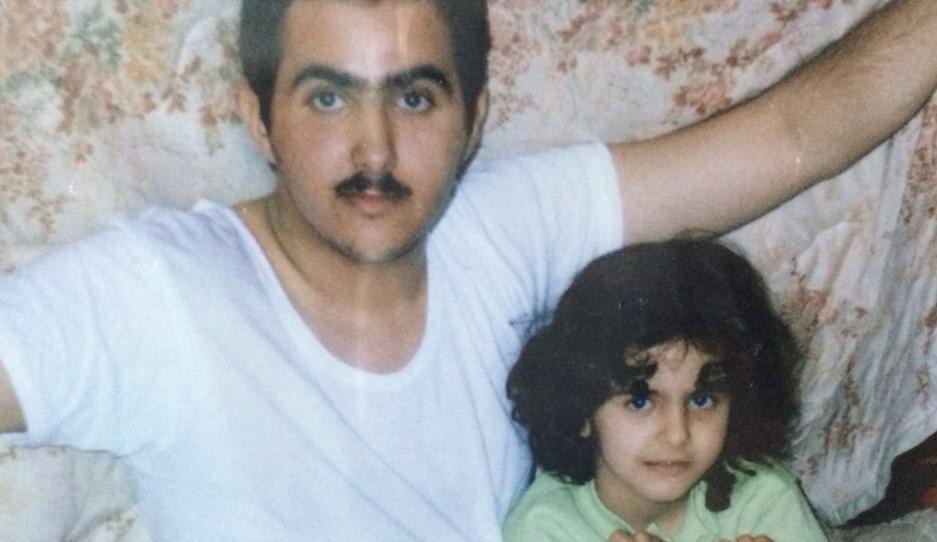
Sitting in a cafe in the small hilly village of Al-Zarqa in southern Saudi Arabia, a retired cartoonist saw a familiar face enter and instantly knew something was wrong. It was the same man who was seated next to him on a flight from a wedding in Jeddah.
The man, trailed by several security agents, rushed inside and arrested Mohammed Alhazza on February 13, 2018 , his sister, Asrar Alhazza, told Capital News Service in an interview.
Alhazza, 49, was taken away in shackles and a blindfold. Shortly afterward, agents raided his home in front of his pregnant wife and youngest child. They ransacked his home office and confiscated his devices.
“It was very inhumane, both his arrest and the way they raided the house,” said his sister, who lives in the United States. He has been in prison for nearly eight years.
Alhazza worked as a freelance cartoonist at the Qatari news outlet Lusail. His satire focused on Saudi and Qatari society. He made fun of the habit of napping on Eid, a major Muslim holiday, and of the 2017 diplomatic crisis between Qatar and Saudi Arabia. After recognizing the gravity of the crisis, he quit his job a few months later.
The Saudi Specialized Criminal Court charged Alhazza with sympathizing with Qatar, according to the Committee to Protect Journalists, a New York-based advocacy group. At the time, Saudi Arabia had accused Qatar of terrorism and sympathizing with the Muslim Brotherhood, a fundamentalist Islamic organization considered a terrorist organization by most Persian Gulf nations.
Alhazza was found guilty and sentenced to six years in prison. In 2023, however, his case was reopened and he was again convicted and sentenced an additional 17 years on charges Asrar said were never made public.
He is held at the Dhahban Central Prison, a maximum security prison in Jeddah, the second largest city in the kingdom.
The Embassy of Saudi Arabia did not respond to a request for comment.
“There is this fear that if [the Saudis] allow public criticism, that more people will adopt a critical attitude,” said David Commins, professor of history at Dickinson College, in Carlisle, Pennsylvania. “It’s not enough to keep your head down. You have to raise your voice in support of the establishment.”
A year before Alhazza’s arrest, Saudi Arabia and three other Arab countries had severed diplomatic ties with Qatar. Saudi Arabia banned Qatari citizens from entering the country, which Alhazza made fun of in one of his cartoons.
Qatar’s close ties with Iran, which Saudi Arabia views as a significant threat to its stability, factored into the blockade, Commins said.
Relations were mended in 2021, causing Asrar’s family to be hopeful for her brother’s release.
Saudi Arabia, a monarchy ruled since 2017 by Crown Prince Mohammed bin Salman, has no independent media outlets. All news organizations and blogs require government approval, and all newspapers are either indirectly or directly owned by the government, according to Ebithal Mubarak, a Saudi journalist living in the United States.
Nineteen journalists are imprisoned, according to Reporters Without Borders, a nonprofit organization promoting independent media worldwide.
In 2018 Prince Mohammed drew international criticism for what the CIA determined was likely his role in the gruesome murder and dismemberment of Washington Post columnist Jamal Khashoggi inside the Saudi consulate in Istanbul. Once a Saudi royal family loyalist, Khashoggi had fled Saudi Arabia a year prior and had written critically of the crown prince’s leadership and government.
This year President Donald Trump, who, along with his extended family, collected an estimated $50 million from deals connected to Saudi Arabia in 2024 alone, according to Forbes business magazine, welcomed Prince Mohammed to the White House and cast doubt on the CIA’s assessment.
In June, Prince Mohammed’s government executed journalist Turki al-Jasser, a blogger who tweeted his criticism of the government and had been imprisoned for seven years for what press advocate organizations called an arbitrary detention. The monarchy uses anti-cybercrime and counterterrorism laws to silence critics, according to Abdulla Alaoudh, the senior director at Middle East Democracy Center, a nonprofit group advocating for the release of wrongfully imprisoned people in the Middle East and North Africa.
“The purpose of the law is to control what you can say in public in Saudi Arabia, and to control what is allowed and what is not,” said Alaoudh. His father, Salman Alaoudh, a famous Islamic scholar, has been in prison since 2017 for criticizing Prince Mohammed
Alhazza had been drawing cartoons for as long as his sister could remember. The father of five was also an Islamic studies teacher with a passion for music and art.
He supported the crown prince’s reforms, which relaxed the religious social environment in the country, she said. As soon as women were allowed to drive, he rushed to teach his sisters.
“I remember when they allowed driving in Saudi, he called me and told me how happy he was and that things are going to be great in Saudi,” Asrar said.
Asrar last visited her brother in 2021, before she moved to the United States. She was able to reach her brother in prison from the United States via phone until the Saudi government shut down her communication with him in 2025.
She says her brother’s imprisonment has taken a harsh toll on his family. Their mother became severely depressed and has not been able to leave the house to visit her son in prison. Alhazza’s youngest son, born during his imprisonment, has only seen his father inside the prison walls.
“He is a great father, a loving father,” Asrar said with tears in her eyes. “If we had two Mohammed Alhazza’s, the world would be a better place.”